
FWCP Basic Safety Regulations
1 Preamble
This is an English translation provided for information only. The only official version is the French version.
The FWCP Basic Safety Regulations (BSR) is, as its name suggests, a document which lays the foundations for a safe practice of parachuting sport at the FWCP.
This regulation is divided into three parts:
• The first part consists of a brief description of the organization of the skydiving in Belgium and his involvement in different organizations.
• In the second part, the safety requirements, including definitions of authorized limits, are described.
• Finally, education, which constitutes one of the foundations of security policy, will be examined in detail.
2 Organization of skydiving sporty
2.1 The FWCP (Federation Walloon of Clubs of Skydiving)
The FWCP is a governing organization/federation whose statutes have been established by the associations which, in Wallonia, practice sports parachuting.
The general purpose of the FWCP is to promote and regulate sport parachuting in all its aspects.
The FWCP is recognized by ADEPS and the French community. It represents the sports parachutists with administrations and different organizations.
And in doing so:
• Obtains the necessary authorizations for FWCP centers or clubs based on the established criteria.
• Responsible for the establishment, extension and recognition of certificates and licenses as well as the presentation of records to sports commissions concerned.
• Organizes the FWCP regional championships and, in the presence of participants from other communities, national championships.
• Selects FWCP skydivers for participation in competitions international.
• The FWCP is responsible for enforcing basic safety regulations that have an obligation for its members.
• The FWCP is responsible for the training of parachutists as well as its executives instructors.
2.2 The Federation Belgian of Skydivers (FBP)
The FBP is the coordinating body which brings together, in addition to the FWCP, the Federation of Flemish paratroopers (VVP). This association aims to harmonize the regulations between the regional federations and to represent the parachutists to the national organizations. It also sets the conditions for participation in international competitions.
2.3 Administration of Aeronautics (DGTA)
Sport parachuting is, in Belgium, under the authority of the Administration of Aeronautics which depends on the FPS Mobility and Transport and is governed by the directive GDF-05.
This regulation provides that parachute jumping, outside of an emergency situation, is prohibited.
in Belgium, unless special authorization is obtained from the authorities concerned.
In the circular, skydiving is defined as jumping from an aircraft, which implies that BASE jumping is not considered a skydiving activity.
2.4 Aero Club Royal of Belgium (AéCRB) and the Federation Aeronautics International (ISP)
The Fédération Aéronautique Internationale (FAI) is represented in Belgium by Aero Royal Club of Belgium (AéCRB) of which the FWCP is a member.
Within the FAI, responsibility for skydiving lies with the Commission.
International Parachuting (IPC).
The AéCRB issues sports licenses and sets the conditions for the establishment or improving records. The AéCRB appoints the sports commissioners and issues the performance certificates.
The conditions and requirements for issuing licenses are included in the code FAI section 5: skydiving (see Appendix A: Criteria for obtaining FAI certificates).
Higher certificates may be issued in accordance with the requirements of the AéCRB sports commission.
2.5 ADEPS (Administration of Education Physics and of Sports)
ADEPS is an organization emanating from the French Community which is responsible for the organization and coordination of sporting activities in our community. The skydiving being considered an official sporting activity, the FWCP turns to this body for questions relating to general guidelines and the policy regarding sports practice.
3 Prescriptions of security
3.1 General
• Anyone who performs a parachute jump must have insurance to legal standards. No one may perform a jump and no pilot may authorize a jump if the latter constitutes a danger for aircraft and/or parachutists and/or for people and/or property on the ground. Under the term jump parachute are taken up both free fall and canopy flight, from the start of the aircraft upon landing.
• The basic safety regulations of the FWCP present, for the clubs which are there affiliates, an obligation and deviations from it are only permitted upon written dispensation from the Technical Director and the President of the FWCP.
• Everyone, whatever their level, is expected to know and respect the regulation of security of base of the FWCP (displayed in each center). However, each center can issue more restrictive rules at home.
• Taking substances that can alter consciousness, such as alcoholic drinks, tranquilizers, etc. leads for the entire duration of their action a reduction of capacities and consequently, leads to a jumping ban. In this context, we will refer to the order regulations interior (KING) item 2. He is recalled that one tolerance zero is applied in material blood alcohol content and of consumption of drugs. Each center can, if he the wish, proceed to of controls or tests appropriate.
• In the event of serious or repetitive non-compliance with the above-mentioned rules, the those responsible for the jump centers must take sanctions which will be noted in the offender's jump log and communicated to the FWCP.
• Everything non-compliance serious of RSB by a parachutist and, to more strong reason by a holder of an instructor certificate, will be subject to a disciplinary commission which may, after hearing a statement of the facts, propose a sanction with regard to of the offender. The sanction within the club can, however, be more severe.
• In the event of an incident, a report must be written (see Appendix B: Declaration incident/accident) so that parachutists and other centers can learn from it.
3.2 Responsibilities at course of jumps in parachute
The center manager ensures the general functioning of the center. A manager technical (RT), duly qualified, ensures responsibility and coordination of activities jumps in progress and must, therefore, be physically present during this activity.
If there is no RT physically on site, responsibility can be given to a instructor who is at least also an AFF and/or TANDEM instructor and in this case, only minimum C certificates can skip.
The responsible of center can be also be the RT if he has the certificates required.
However, this is discouraged by the FWCP, in order to separate technical decisions operational decisions.
The air center operator ensures responsibility for compliance with air regulations and general safety on board his aircraft.
Students* can only perform jumps under the responsibility and presence of a qualified instructor on board the aircraft (*student = not holder of the A certificate).
In all other cases, the presence on board of a holder of at least one C certificate is required.
There is a difference in level and responsibility between the jumps that are performed in the centers and those that are carried out in other places, such as jumps demonstration.
Summary Jumps performed in a club or center OA student FWCP C certificate or Who jumps?
Free fall FWCP A certificate FWCP B certificate more AFF Responsibility Responsible Responsible Responsible Responsible general technical technical technical technical Responsibility Instructor AFF in The parachutist himself The parachutist himself The parachutist himself for the jump / load even even even accompaniment Responsibility Instructor AFF in The parachutist himself Jump Master Jump Master on the plane load even Demonstration jumps Holder of a minimum C certificate with authorization from an RT Who jumps?
RT or instructor designated by the center to supervise jumps from General liability demonstration, if its presence was imposed by the center (optional) Responsibility for the jump The skydiver himself Instructor designated by the center to supervise jumps Liability in the plane/aircraft demonstration, if its presence was imposed by the center (optional) or holder of a D certificate designated by the center
Synthèse
Sauts effectués dans un club ou dans un centre
| Qui saute ? | Elève OA Chute libre AFF | Brevet FWCP A | Brevet FWCP B | Brevet FWCP C ou plus |
|---|---|---|---|---|
| Responsabilité générale | Responsable technique | Responsable technique | Responsable technique | Responsable technique |
| Responsabilité pour le saut / accompagnement | Instructeur AFF en charge | Le parachutiste lui-même | Le parachutiste lui-même | Le parachutiste lui-même |
| Responsabilité dans l’avion | Instructeur AFF en charge | Jump-Master | Jump-Master | Le parachutiste lui-même |
Sauts de démonstration
| Qui saute ? | Titulaire d’un brevet C minimum avec autorisation d’un RT |
|---|---|
| Responsabilité générale | RT ou instructeur désigné par le centre pour superviser les sauts de démonstration, si sa présence a été imposée par le centre (facultatif) |
| Responsabilité pour le saut | Le parachutiste lui-même |
| Responsabilité dans l’avion/aéronef | Instructeur désigné par le centre pour superviser les sauts de démonstration, si sa présence a été imposée par le centre (facultatif) ou titulaire d’un brevet D désigné par le centre |
3.3 Conditions of participation
Any candidate for sports parachutist training must be at least 16 years old in the current year.
Before the start of the training, the candidate must have passed a medical examination.
In addition, before the start of the training, the candidate must have taken out insurance in compliance with the Royal Decree of July 4, 1978 which defines the terms of insurance covering sports activities.
3.4 Conditions weather
3.4.1 Visibility and cover cloudy
Paratrooper drop flights comply with weather guidelines from the Aeronautics Administration.
For paratrooper drops, the rule is that cloud cover should not be less than 3,000 ft AGL (above ground level) and visibility in the area should not be less than 3 km.
3.4.2 Wind
Before practicing parachute jumps, it is obligatory to know the conditions of wind both on the ground and at altitude.
Maximum allowable ground wind speed:
• Until certificate B included : maximum 7 m/sec ;
• A leave of certificate B : maximum 12.86 m/ dry. (25 nodes) (GDF 05)
• Exception: night jumps: maximum 7 m/sec.
The Responsible Technical during the operations can impose of limits more severe if he the judge necessary at seen of conditions meteorological.
3.5 Altitudes of security
Safety altitudes are always expressed in relation to the landing location (above ground level). Depending on the type of jump, the equipment used or the level From experience, the minimums cited below can be increased.
All skydiver must have activated the opening of their parachute above 3000 ft AGL. (He must always take into account the opening distance of his sail!)
4 Equipment for the jumps
4.1 Parachutes
The requirements which are linked to a parachute must in no case exceed the possibilities of the user, whether at the level of experience or knowledge.
The jumping equipment must include at least the following elements:
• a harness with the bag for the sails;
• a suitable main parachute;
• an approved reserve parachute which should only be used if necessary;
• an AAD in working order.
The owner of a parachute is the one who, on the front line, is responsible for the correct composition of his equipment.
The assembly of equipment must be carried out in accordance with the requirements of the constructor.
Before initial commissioning, in the event of a change of owner and at least once a year, the equipment must be checked by a technician (rigger) and declared good for service.
Structural modifications or repairs which may jeopardize the flight characteristics of equipment must be carried out exclusively by a master rigger. A list of “ riggers » is annually communicated by the commission of riggers to the FWCP.
Each parachute must have a parachute logbook listing the identification of the parachute(s).
owner(s), annual checks, repairs, etc.
Before each jump, important parts of the equipment must be checked by the user (pin check, etc.). For parachutists who do not yet hold the certificate B, this check must be carried out by an instructor.
It is recommended that before the jump, skydivers check each other's equipment.
4.1.1 Folding of parachutes
4.1.1.1 Parachute main
A. Student parachute (club equipment):
Responsibility for packing and controlling the main parachute is solely the responsibility of the a rigger or a checker approved by the club who has proven his abilities or the user himself, provided that he holds at least the A certificate and has proven his abilities.
B. The other main parachutes
The folding and control of the other main parachutes are carried out under the responsibility individual of each parachutist, provided that he holds at least the A certificate and/or that he has proven his abilities.
The folding of tandem parachutes can be carried out by non-skydivers, provided that they have proven their abilities. Instruction and qualification are organized by center managers.
4.1.1.2 Parachute of relief
Folding emergency parachutes and closing reserve containers must always be carried out in accordance with the manufacturer's instructions.
All reserve parachutes must be sealed. The lead must bear indications allowing the folder to be identified.
The folding of emergency parachutes can only be carried out by a technician.
parachutes/rigger. Each reserve parachute is assigned a folding sheet (which may be electronic) on which must be mentioned:
• the date of the folding
• other manipulations
• the name of the folder or handler Each emergency parachute must be periodically opened, checked and retracted in compliance with the manufacturer's instructions. The technical management sets, in agreement with the board of directors, a time interval between periodic foldings of way to standardize procedures.
Currently, the reserve parachute must be checked once a year for the FWCP.
4.2 Instruments
4.2.1 Altimeter
The use of an altimeter that is readable and clearly visible when falling and is obligatory in all circumstance.
The use of an audible altimeter for safety reasons is only authorized from obtaining the CSC certificate.
4.2.2 AAD
All equipment must be equipped with a safety opening device automatic AAD (Automatic Activation Device) operational (therefore switched on). The AAD devices must be maintained and periodically tested in accordance with the manufacturers' recommendations.
Mechanical AADs (FXC type) are prohibited.
4.3 Equipment of protection
The port of helmet is obligatory for all the jumps, except the jumps bass altitude with opening almost immediate until certificate B and is also always obligatory during a flight in training. For of reasons of security, the helmet integral is not not authorized before the B certificate (50 jumps).
Footwear must provide sufficient protection.
If gloves are used, they must not reduce the mobility of the hands and fingers or interfere with emergency procedures.
For all free fall jumps, it is advisable to protect your eyes adequately.
appropriate (goggles or full-face helmet).
No part of the parachutist's clothing can influence the execution of the procedures emergency. This also, of course, applies to the rest of the equipment.
4.4 Cameras
Before being allowed to carry a camera and/or still camera, the parachutist must be at least the holder of the FWCP C certificate and have read and understood the recommendations published by the FWCP (see Appendix G: Free fall manual with camera).
For camera jumps accompanying an AFF jump, the accompanying videoman an AFF jump must be an AFF instructor himself and obtain the agreement of the instructor(s) AFF.
For camera jumps accompanying a tandem, the tandem master must give his agreement. The videoman must have a minimum of 400 jumps and pass the theoretical and practices published by the FWCP (See Appendix H: FWCP Tandem Video Certificate) For tandem instructors, a minimum of 500 tandem jumps is required to carry a handycam.
The use of a visual altimeter and an audible altimeter is mandatory to carry out camera jumps.
Carrying a camera on the helmet presents risks, among other things during a liberation. Therefore, helmets must either be equipped with a release system or the camera-support assembly or the support itself must not have any protrusion or possibilities hanging (by example model of type “ cookie "). The character “ snag free » of helmet must imperatively be validated by a responsible technical. If this one decide of don't not the validate, the helmet must be equipped of a system of liberation for be used.
Whatever the type of jump, the use of a “pole” where the camera is fixed is prohibited.
Finally, in all the case mentioned above, the helmet must be kept on the head until landing. He don't can in none case be removed under veil under the pretext, by example, of do of pictures.
4.5 Knives (hook knife)
To leave of 1st July 2026, the takeaway of a knife of security of type hook knife is obligatory for all the paratroopers, without exception. This one must be placed of way to be easily and quickly accessible by the parachutist.
This knife must be constituted of carbon, aluminum or of everything other material composite rigid. The knives entirely in plastic don't are not authorized.
For the jumps in tandem, a knife placed on the harness of passenger is considered like sufficient. In this frame only, a knife of type Jack the Ripper can be used, with a handle in plastic reinforced in fiber of glass, carbon or material similar.
The briefing relative to the use of knife will be integrated to the training theoretical initial fall free. The dots following will have to in particular be addressed :
• location and accessibility of knife ;
• case of use possible ;
• risks related to a bad use ;
• techniques and instructions of use.
5 The planes and the areas of jumps
5.1 Planes widths
The rules for compatibility of an aircraft with paratrooper dropping operations are set by the Aeronautics Administration. The radio equipment on board must allow bilateral communication with air traffic control.
For self-opening jumps, the static line must be attached to a point on the structure of the aircraft in accordance with the manufacturer's specifications.
If necessary, the automatic opening strap must be able to be cut.
All persons on board an aircraft carrying out a parachute drop must wear a parachute.
The pilot of a drop plane must hold a specific authorization. A member holder of a private pilot license may request this authorization from the Administration of Aeronautics.
The pilot, or the operator aerial, is responsible of respect of regulations aeronautics and general safety on board. In collaboration with the person responsible for the drop, the pilot will ensure that all measures are taken to ensure that the jumps take place safely.
5.2 Areas of jumps with activity permanent
The approval of a drop zone depends on the direction of the Administration of Aeronautics which gives its agreement or not. Authorization is only ever given for a limited period and it can be withdrawn at any time, particularly when the technical and/or administrative requirements are not or no longer respected.
For technical and administrative requirements, please refer to the circular of the Directorate of the Aeronautics Administration.
5.3 Areas for jumps of demonstration
See chapter 8 - Demonstration jumps or casual area jumps
6 Instruction and disciplines
6.1 The instruction of basis.
6.1.1 Opening automatic/static line
6.1.1.1 Definition
Self-opening jumps are jumps during which the parachute is opened by means of an opening strap (SOA/static line) which is connected to the aircraft.
6.1.1.2 Training
The automation training consists of 2 parts:
1. Ground training:
The training includes at least the following elements, which must be given by a approved instructor:
• jumping and descent under sail,
• specific procedures under canopy and upon landing,
• emergency procedures,
• the components of the parachute and the folding of the main sail.
The FWCP holds a copy of the instruction manual which has been approved by the commission.
The candidate must take a theoretical exam and have passed it to be able to consider his ground training as complete.
2. Practical training/jumps:
A maximum of one month can pass between ground training and practical training.
The student will be constantly monitored and taken care of until the jump by the instructor. He It will be desirable for a second instructor to take charge of the student for landing. A Radio contact between this instructor and the student is recommended. After the jump, the student will receive a “debriefing” during which the instructor will point out any errors committed. Remarks and comments will be recorded in the jump log.
the student.
From the 2nd jump in automatic opening, the parachute opening gesture main can be simulated, in preparation for progressing towards the commanded opening.
The indicator handle must be identical and in the same location as the handle used for free fall.
The course is considered successful when the student is able to leave the plane without loss of stability. The decision rests with the responsible instructor in agreement with the center manager. The (positive) decision will be noted in the jump log and will be signed by the instructor. To be able to begin free fall training (method traditional), the student must, in addition, during 2 consecutive jumps, perform a control handle without loss of stability. The last control handle and the first jump fall must be carried out during the same weekend.
6.1.1.3 Material
A) The main parachute must make it possible, even in the event of a student error, to ensure a landing in good safety conditions and be configured by the manufacturer like a parachute student. This means, among other things, that this parachute:
- has the controls adjusted in such a way that they make any maneuver impossible extreme;
- has been previously tested and adjusted.
B) Parachute equipment must include the following elements:
• for the harness bag: an RSL (Reserve Static Line) device
• an AAD device (Automatic Activation Device)
6.1.2 The fall free (training traditional)
6.1.2.1 Definition
Free fall training (using the traditional method) is the logical continuation of the automatic training, the student only learning to activate the opening of the his parachute after leaving the plane.
6.1.2.2 Training
A) Responsibility Free fall training takes place under the responsibility and control of an instructor competent. The instructor evaluates each jump and records his observations in the notebook of student jumps.
B) Free fall part The first jumps are used to learn the correct position and opening of the parachute by stable position.
For the rest of this training, you can refer to the course established by the ad hoc commission.
hoc.
When the student has completed his free fall training by having satisfied a safety test, he is declared by the instructor, in agreement with the center manager, “admitted outside the student status. The decision is notified in the student's jump log and signed by the center manager.
6.1.2.3 Interruption of the training fall free traditional
Although it is always possible to interrupt progression in free fall at any moment to resume it later, it is however recommended to avoid such interruptions.
After an interruption of 6 months or more, you will be asked to repeat one or two jumps of one level lower than that acquired before the interruption; this type of jump will be decided by the center manager. In the event of a positive evaluation of this or these jumps by an instructor, the student will be able to resume the training where he left off.
6.1.2.4 Material
See 6.1.1.3 above
6.1.3 Fall free: Accelerated Free Fall (AFF)
6.1.3.1 Definition
AFF training was developed in the USA; it allows the student to carry out, in seven stages or levels, free fall jumps in safety and in a completely controlled.
Within the federation, the first jump (since 2019) is a didactic tandem jump.
During these 7 levels, the student will be accompanied, for levels 2 and 3, by two instructors then, from the 4th level, by a single instructor (or two if necessary).
Clubs are authorized but not obliged to include “indoor” wind tunnels in the training.
The training constitutes a single module and is based on the standards established by the USPA (United States Parachute Association). These have been translated into the form of courses for AFF and applied instructors.
Essential deviations from this doctrine must be agreed with the competent commission and approved in writing by the technical management.
6.1.3.2 Training
For the content of this training, please refer to the course established by the ad hoc commission.
hoc.
The qualified instructor decides, in agreement with the center manager, to release the student when he has successfully completed his training. The decision is notified in the notebook of the student’s jumps and signed by the qualified instructor.
practical.
A maximum of two months can pass between ground training and training.
6.1.3.3 Interruption of the training AFF
• During AFF training, we will check on the basis of the jump log whether the goals of the previous jump have been reached. After an interruption, you can always have to bring the student down to a lower level.
• An AFF student who has not completely completed his training must, in the event of interruption of more than 3 months, resume with a jump of level 4 or lower.
• An AFF student who has completed his training but does not yet have the A certificate must, in the event of an interruption of more than 3 months, resume with a level 4 jump.
6.1.3.4 Material
See 6.1.1.3 above
6.2 Stop of long duration
A skydiver who has less than 100 jumps and who has not jumped for more than a year must redo a theoretical refresh and, if necessary, an AFF jump whose level will depend on the appreciation of the instructor.
6.3 The disciplines
Further training begins directly after the free fall instruction is completed.
completed, whether you follow the classic method or the AFF method.
The transition from basic training to further training is generally accompanied of acquiring your own jumping equipment.
It is important, at this level, to check whether the parachutist has been trained in the type of opening of his parachute. It will not be recommended, when learning a discipline, to change the type of equipment that we use.
Any change in equipment type will require a briefing by a competent instructor and carrying out exercises intended to create automatism in the use of the new material.
6.3.1 Accuracy landing
6.3.1.1 Definition
Precision jumps are jumps during which an effort is made to land on or as close as possible to a specific location.
6.3.1.2 Conditions
In principle, one should be able to start precision jumps from the first jump.
However, care must be taken to ensure that the student does not make any dangerous maneuvers.
with the aim of reaching the target at all costs.
6.3.2 Jumps of aerobatics (style)
6.3.2.1 Definition
Aerobatic jumps are jumps during which a series of prescribed figures must be performed during free fall.
6.3.2.2 Conditions
You can start performing aerobatics when you have successfully completed it.
free fall training using the traditional method or AFF.
6.3.3 Jumps in training (flight relative or training skydiving)
6.3.3.1 Definition
The jumps in training have for goal of train during the fall free of training in flight to dish prescribed with a group of paratroopers (minimum 2 people).
6.3.3.2 Conditions
To participate in training jumps with skydivers other than an instructor, a parachutist must have at least completed their traditional free fall or AFF training, have carried out finished and successful the training CSC (course of security in fall) with a qualified instructor (see Appendix D: CSC Instructor Certificate (detail)).
The prerequisites for starting and completing CSC training are defined in the Appendix E: CSC Guide Lines FWCP.
6.3.4 The veil contact (CRW or Canopy Relative work)
6.3.4.1 Definition
The aim of contact canopy jumps is to achieve prescribed parachute formations open.
6.3.4.2 Conditions
Beginners in contact sailing must hold at least a C certificate.
He must follow a course under the direction of a initiator instructor qualified. These jumps will be listed in the jump log.
The contact glider instructor decides whether the parachutist has satisfied the course and notifies him in the notebook of jumps who will be signed by the responsible of center. The instructor veil contact not being not trained by the FWCP, he will be able to be recognized by the FWCP and his direction technical on base of training and experiences in others federations.
For this discipline, the use of a RSL is not not authorized and the presence of a knife is obligatory (hook knife).
6.3.5 Skysurfing
6.3.5.1 Definition
Skysurf jumps are jumps in which the skydiver flies on a board clinging to his feet.
6.3.5.2 Conditions
• Minimum technical level
• Perfect control of body position in stand-up (standing fall), exit at the opening altitude;
• Perfect control of body position during the following exercises:
• 360° pirouette left and right in stand-up position;
• Stand-up – backflip – stand-up;
• Stand-up – front somersault – stand-up;
• The possibility, in a stand-up position, to remedy any instability.
During the first 25 jumps, these exercises will be performed with a small board.
size, on which the feet are placed side by side. Subsequently, one more board large size can be used on which the feet will be positioned one behind the other.
Appreciation of abilities before the first skysurf jumps, as during the following steps, will be left to the center manager or a competent initiator designated.
A parachutist who would perform skysurf jumps without having received proper training hoc would be immediately sanctioned by the center manager.
6.3.5.3 Equipment for the jump
• No seated fall combination with single or double wings for 10 first jumps or during preparatory free style jumps.
• Sports shoes that provide good support for the joint without limit flexibility.
• An additional sweater, free style or skysurf wetsuit are recommended.
• Free style gloves are, in all cases, recommended.
• The use of an audible altimeter is mandatory.
6.3.5.4 Board of surfing
When the weight/surface ratio exceeds 0.7 kg/cm², the board must be equipped with a brake parachute. If this ratio is less than 0.7 kg/cm², a brake parachute is prohibited. For medium (1.2 m) to large boards (75% of the parachutist’s height), parachute brake is not recommended.
The system for attaching the feet to the board must be constructed in a stable and simple and must be characterized by a rapid hook-up in the plane and a stall guaranteed in case of problem.
On the lower surface of the board, all attachment points must be protected from so as to avoid any damage to the aircraft. It is recommended that the board be edged with rubber to provide protection at the exit in the event of skysurfer training or when stalling.
A release cushion to unhook the board will be located at the height of the pelvis of the parachutist and must be able to be reached in a tense position. Activation of the system stall must be repeated on the ground and a certain stall must each time be obtained.
The skysurfer is, in all cases, solely responsible for the quality of his board and this The latter must be approved by the center manager.
6.3.5.5 Rules of security
• Exit, safety checks, stand-up position, sitting position and opening simulation will have to be repeated extensively on the ground before the first jump. An initiator will control and assist these exercises.
• The first 25 jumps will be done with a beginner's board. Height minimum jump will be 10,000 ft AGL and, during the first jumps, the opening parachute will be done between 6,000 and 5,000 ft AGL. Gradually, the altitude opening may be reduced to 4,500 ft AGL.
• Then, a minimum of 30 jumps performed with an intermediate board to be able to move on to a board for advanced riders.
• To open the parachute, you must adopt a stable position for which we have trained beforehand, so as to be sure that the extractor can function properly. In the event of irrecoverable instability, the board must directly be unhooked before the parachute can be opened.
• In the event of a problem with the main parachute when opening the board to the feet, it you must first unhook it before releasing the main sail and opening the reserve parachute. The use of an RSL is prohibited and the presence of a knife (hook knife) is mandatory. The extractor must be located under the main bag (BOC) and cannot, under any circumstances, be located on the leg guard (ROL).
• Skysurf training jumps can only be entered by skydivers with more than 100 skysurf jumps. To accompany a skysurfer, a parachutist must have at least the C certificate and have received a briefing from a initiator and the skysurfer himself.
6.3.6 Freeflying
6.3.6.1 Definition
Freefly jumps are characterized by a greater fall speed which is achieved through different positions such as: seated fall, stand-up (standing) or headdown.
6.3.6.2 Equipment of jump
Velcro on the bag is not recommended. The opening system must be either a hand deployed under the main bag (BOC), i.e. a pull out.
Before being authorized to participate in a Freefly jump, the parachutist's equipment must have been checked by a qualified instructor or rigger and have been declared “good for the service”.
An audible altimeter and hard helmet are mandatory. (see Appendix C1: Freefly Certificates)
6.3.6.3 Progress in freefly
The first jumps must be done in a seated fall. As soon as the parachutist arrives at master this position (i.e. move in a seated fall, forwards and backwards as well as than performing voluntary and controlled 360° turns), he can begin to get into standing fall (stand-up). Only then will he move to the head down position.
(headdown).
The first jumps in formation can only be performed after having followed a training with a qualified freefly instructor (see Freefly Certificate: FF-A Head Up beginner) which will determine the type of future jump that the beginner will be able to perform.
To perform formation jumps, the beginner must hold at least a certificate Freefly B.
The various freefly certificates are listed in Appendix C1: Freefly and track certificates
6.3.7 The flight in wingsuit
6.3.7.1 Definition
Wingsuits are suits with cellular wings on the arms and legs and aim to obtain, by reducing vertical speed, a strong increase in horizontal displacement.
6.3.7.2 Conditions
Wingsuit manufacturers generally recommend a minimum of 500 jumps.
However, with authorization from a technical manager, training may begin at leave of certificate C of the FWCP. The practical of the Wingsuit don't can start that under the supervision of a instructor wingsuit qualified in order to obtain the certificate WS-A.
See Appendix F: Certificates and progression for Wingsuit practice at FWCP
6.3.7.3 Progress in wingsuit
The certificates obligatory for the progression in wingsuit se find in Appendix F : Certificates and progression for Wingsuit practice at the FWCP - Progress and progression program certificates: and are obligatory at breast of the FWCP.
6.3.8 Canopy Piloting “ SWOOP »
6.3.8.1 Definition
The swoop is a discipline consistent to carry out a approach to high speed with socket of speed dynamic before a passage extended to weak height above of ground. This practical aims to optimize the performance, the distance or the precision of piloting under veil.
6.3.8.2 Conditions
• Be holder of certificate D of the FWCP (500 jumps)
• Using an AAD specific to swoop is strongly recommended
• Have followed a specific course.
• Have received authorization from a technical manager
6.3.9 Flocking under veil
6.3.9.1 Definition
The flocking under veil is a practical consistent to realize of training under veil and of movements coordinated between several paratroopers, according to a trajectory and a organization predefined, everything in now of distances of security adapted.
6.3.9.2 Conditions
• Be holder of certificate C of the FWCP minimum
• Have received the agreement of a Responsible Technical, in the wait of a progression more specific developed by the FWCP.
6.4 The jumps specials
All special jumps whose standards are defined below are subject to authorization from a technical manager of the center.
6.4.1 Jump tandem classic – Jump tandem wingsuit
The tandem jump is a jump during which one person (the tandem passenger) can perform a parachute jump with a large wing while hanging on to the means of a special harness, to the harness of a parachutist (the tandem instructor) who has received special training.
6.4.1.1 Conditions
The tandem jump is performed by tandem instructors in accordance with the instructions from tandem equipment manufacturers. The passenger must complete the following conditions:
• Be of a size that allows you to wear the passenger harness.
• Minors (under 18 years old) must present written authorization from the parents or those who are responsible for them.
• Have validated a declaration of (good) health and don't not present of anomaly obvious physical condition that could increase the risk of jumping. When in doubt, the advice of a doctor should be sought.
• People who present a physical abnormality will not be able to jump only after authorization from the doctor and the center manager and with a tandem
• Have received information relating at least to the exit from the plane, the progress of falling and landing, whether under normal conditions or particular.
• Have taken out insurance, via the center or another means.
6.4.1.2 The material
The tandem system must meet the following requirements:
• Description: The equipment for tandem jumping must have been designed for this purpose and must consist of a bag assembly with a harness that allows hanging on the in front, the passenger harness. In addition, the equipment must be equipped with an AAD specially calibrated for tandem jumps.
• Authorization: The complete system must have been, in its country of origin, tested and approved by an official body and must also be approved by the FWCP.
• Safety standards: The minimum altitude to perform a tandem jump is 6,500 ft AGL. o The minimum opening altitude is 5,000 ft AGL. o The use of a visual altimeter is mandatory; the audible altimeter is o also mandatory when using a handycam. Freefly jumping with a tandem passenger is prohibited by the manufacturers. o
6.4.1.3 Special features of tandem wingsuit
• The tandem wingsuit jump is governed by the same conditions as the tandem jump classic.
• A representative of this specialty must be approved and approved by the FWCP: See Appendix J
• It is carried out by an instructor with tandem and wingsuit qualifications and prerequisites imposed by the FWCP referent.
• The tandem and wingsuit instructor will have received theoretical and practical training provided and validated by the FWCP referent. He will present the document attesting to it.
• The tandem wingsuit instructor will choose and train his Flight Operator according to the rules established by the FWCP referent
• If necessary, clubs will adapt their Internal Rules and Regulations and others legal provisions for the practice of tandem wingsuit jumping in their facilities. These rules may be more restrictive than those formulated by the referent of the FWCP, but no less.
• Details: See appendix J
6.4.2 Jumps of night
6.4.2.1 Definition
Night jumps are jumps that are performed in part of the day including between 30 minutes after sunset and 30 minutes before sunrise.
6.4.2.2 Conditions
• To perform a night jump, you must obtain all aeronautical authorizations necessary, that of the aerodrome on which the jumps are carried out as well as the technical director of the FWCP. They must be requested by the director technical center.
• The maximum permitted wind speed is 7 m/sec. Visibility cannot, in any way case, be less than 8 km and the landing zone must be adequately lit such that, from the plane, the runway can be distinguished from the landing zone of the paratroopers.
• Paratroopers must have at least the C certificate level and have received a information specific to the practice of night jumps.
• Night tandem jumps can only be performed by master tandems experienced persons designated by the center technical director.
6.4.2.3 Equipment
• An illuminated or fluorescent visual altimeter as well as an audible altimeter are obligatory.
• A light that will be clearly visible both in fall and in an open parachute is mandatory.
• A flashlight is recommended.
6.4.3 Jumps in water
6.4.3.1 Definition
Water jumps are jumps where the landing is planned in water.
6.4.3.2 Conditions
• Authorization from the technical director of the center is necessary to carry out jumps into the water.
• Jumps into the water must be carried out with the greatest caution. Even In shallow water, there is a risk of drowning if you become entangled in the parachute. In the case of demonstration jumps carried out near a plane of water, the same safety measures must be applied as for jumps in the water.
• Participants (who must have at least the C certificate) must know how to swim, wear a life jacket and have been informed of its use.
• During each jump into the water, it is obligatory to have a motorized boat with two lifeguards on board with diving equipment.
6.4.4 Jumps of high altitude
6.4.4.1 Definition
These are jumps performed at an altitude greater than 4,500 m or 15,000 ft MSL (Mean Sea Level), i.e. above sea level.
6.4.4.2 Conditions
Above Flight Level 150 (FL150), a risk assessment is required and the Carrying oxygen requirement must be considered.
Regarding boarding the plane, the EASA regulations apply.
The preparation of such jumps must be done in collaboration with the technical director of the FWCP.
7 The certificate instructor and the qualifications
7.1 Principles
• Basic training as well as subsequent training are given in the centers forming part of the FWCP by certified parachutists recognized by the latter.
• The extensions of licenses/qualifications must be noted on the certificate who must power be presented to everything moment during the instruction.
• The highest instructor certification is that of examiner. It allows the holder to give lessons to candidates for the instructor certificate.
• The certificates and qualifications will be delivered by the examiner concerned. the director technical on decision of commissions of qualifications.
• The validations, extensions possible or cancellations of certificates or qualifications are introduced by the person competent for the grant on the platform web “ member » of the FWCP. This platform has a character official. On asks, these validations can also be registered in the notebook of jump of the person concerned.
• The commissions control and organize instructional activities at the FWCP.
• Military and foreign certificates can be recognized by commissions corresponding.
• Obtaining ADEPS certificates will be encouraged.
• Club insurance covers the civil liability of the instructor with regard to students during their activities.
• The FWCP has legal insurance for all instructors.
7.2 The certificates instructor
7.2.1 Conditions access
• Minimum age: 21 years old.
• Be a member of a club/center affiliated with the FWCP.
• Be the holder of certificates and ad hoc minimums at the time of obtaining them.
• Provide a request from the center manager.
7.2.2 Content of course theoretical and exams
• Method/Pedagogy/Communication: is the candidate capable of teaching?
• Responsibilities of an instructor
• Basic knowledge of aerodynamics applied to parachutes.
• First aid (not necessarily given by the FWCP)
• Basic knowledge of jumping equipment (including at least practical examination of control of a student)
• European (EASA) and Belgian (DGTA) organization and regulations
• Basic safety regulations.
• A synthesis of the different disciplines.
• Introduction to meteorology
• Concepts of release
• Altimetry concepts
• Other subjects may be developed in agreement with the commission.
7.2.3 Skills
After having satisfied the theoretical courses, the candidate has the possibility of starting a course to obtain a qualification (cfr 7.3) as long as he has the ability necessary.
someone who, two years after the end of course theoretical would not have always not got a qualification (from sound choice), se would see forced of present to new the exams theoretical.
It goes without saying that the candidate will only be considered as an instructor when he has satisfied in the qualifying events.
The instructor don't can start a qualification AFF or tandem (or all the others qualifications “ superior ") that after a minimum of 6 month in so much as an instructor at breast of the FWCP.
7.3 The qualifications
The qualifications that can be obtained are as follows:
• Instructor with basic qualification
• Instructor CSC (authorized to deliver of certificates of security in fall)
• Instructor with AFF qualification (AFF instructor)
• Instructor with tandem qualification (tandem instructor)
• Instructor Freefly
• Instructor Track
• Wingsuit Instructor
• Responsible Technical
• Examiner (for the qualification instructor)
• Examiner Freefly
• Examiner Track
• Wingsuit Examiner
• AFF examiner
• Tandem Examiner
7.3.1 Instructor (with the qualification of base)
7.3.1.1 Conditions
• Be 21 years old
• 500 jumps minimum.
• 3 years of skydiving at the FWCP
• Have satisfactorily completed the theoretical courses (average of 70% and at least 50% in each subject) and practical (if applicable).
• Have completed a “first aid in a sports environment” course within a maximum of 6 months after passing the exam.
Recipients must have a qualification (CSC instructor, Freefly, Track Wingsuit or higher – AFF – Tandem, etc.) within a maximum period of two years.
A responsible sponsor per candidate will be determined by their center.
7.3.1.2 Content of course
Is established by the technical management of the FWCP, cfr 7.2.2
7.3.1.3 Skills
The instructor with the basic qualification can give theoretical and practical courses for OA students and theoretical lessons for AFF students.
The basic instructor can also take care of the radio guidance of the AFF students.
However, the responsibility for landing always remains with the AFF student.
The basic instructor is trained for and can therefore control the parachute as well as students’ equipment before a jump. However, the responsibility to request a verification remains the responsibility of the student.
The basic instructor with at least 2 years of experience can give the course to parachutists participating in courses and the exam to obtain the C certificate.
If during these 2 years none of these qualifications have been passed, the certificate Basic Instructor is suspended.
To get it back, you have to take the Instructor course again and pass the exam.
The Basic Instructor once again has 2 years to present and successfully complete one of the qualifications of this certificate.
For the award of these qualifications a sponsor will be designated. This sponsor can be different for each qualification
7.3.2 Instructor CSC
The CSC Instructor (fall safety course) is a basic instructor who, with the agreement of an RT has passed the test jump defined by the FWCP. The CSC instructor can issue the certificate fall safety for students who have the prerequisites and have met the requirements necessary (see Appendix E: CSC Guide Lines FWCP) Conditions: Theoretical knowledge of the subject. Teaching abilities. Success a test jump to be carried out with an AFF instructor with video, briefing and debriefing. CFr Appendix D: CSC Instructor Certificate (detail)
7.3.3 Instructor Freefly – Track
A basic instructor qualified to teach and train experienced skydivers in freefly – track jumps; this corresponds to the FreeFly E Certificate (cfr Freefly Certificate: FF-F Freefly Initiator) or the TR-F track certificate (cfr Track Certificate instructor: TR-F Track Instructor).
7.3.4 Instructor Wingsuit
A basic instructor qualified to teach and train experienced skydivers in wingsuit jumps.
Conditions: Be a basic FWCP instructor. Have completed coaching training Wingsuit from a Wingsuit manufacturer (Phoenix-Fly, Squirrel, Intrudair...) or from an organization exterior (FFP, USPA, etc.); see Wingsuit Initiator/Instructor Requirements (required)
7.3.5 Instructor AFF
Conditions: Successful completion of the theoretical instructor course. Be able to justify at least 8 hours in falls and 1,000 jumps. Successful completion of the AFF instructor course under the direction of a FWCP approved examiner.
7.3.6 Instructor tandem
Conditions: Successful completion of the theoretical instructor course. Be able to justify at least 8 hours in falls and 1,000 jumps. Successful completion of the tandem instructor course under the direction of an examiner approved by the FWCP.
7.3.7 Instructor tandem wingsuit
Conditions: meet the conditions set out in 6.4.1.1 and 6.4.1.3 Have the required minimums:
• 500 jumps with controlled and delayed opening, using a device opening with flexible extractor.
• 1500 wingsuit jumps
• 1000 tandem jumps.
7.3.8 Responsible Technical
Conditions: Hold the tandem instructor certificate and/or the AFF instructor certificate.
Have followed and passed the theoretical courses, either tandem or AFF depending on whether you are an instructor AFF, or tandem; have followed and passed the Free Fly -track and Wingsuit theoretical courses, have of good notions of others disciplines. Tracking and success of course Responsible Technical, to define on request with the direction technical of the FWCP, under the direction of an examiner approved by the FWCP.
One year of internship in a center under the supervision of the technical director. Be 6 years old practice and 4 years as an instructor at the FWCP.
A times this qualification obtained, the Responsible Technical can, in agreement with the D.T. of center, officer in so much that responsible technical of a day of jumps without the presence of D.T. on place.
7.3.9 Director Technical
7.3.9.1 Conditions
• Own a certificate of Responsible Technical and have officiated like RT since at least two years under the control of the DT in place
• Be presented by your club, complete an interview with the FWCP board of directors before to take office.
• The technical director of the FWCP (or the technical direction) can decide, in the event where a candidate does not meet all the required conditions, if he can be accepted or not.
• A D.T. can se do replace, for a period determined, by a Responsible Technical who has at less 4 years of experience.
7.3.10 Skills for the different qualifications
The qualifications give the holder the following skills:
• AFF instructor: give lessons (theoretical and practical) to AFF students.
• Tandem instructor: perform tandem jumps with passengers.
• Instructor Free Fly or Track : give the course (theoretical and practices) to candidates who satisfy to prerequisites for obtaining of certificates FreeFly or Trace
• Wing Suit instructor: give lessons (theoretical and practical) to candidates having at least the FWCP C certificate as well as the other prerequisites for obtaining Wingsuit certificates
• Tandem-wingsuit instructor: perform tandem wingsuit jumps with passengers.
• Responsible Technical: officer like responsible technical of a center and give courses to basic instructor candidates and AFF candidates and tandem (if they have passed the ad hoc examiner module)
7.3.11 Validity
The qualification remains automatically valid as long as:
• The AFF instructor brings, either on his own initiative, or via the person responsible for center, proof that he has, during the year, completed at least 25 AFF jumps and 100 jumps. Someone who could not justify these 25 annual jumps will, for maintain your qualification, retake an assessment with an AFF instructor from the FWCP (see AFF course).
• The tandem instructor brings, either on his own initiative, or via the person responsible for center, proof that he has, during the year, performed at least 25 tandem jumps and 100 jumps. Someone who could not justify these 25 annual jumps will, for maintain your qualification, retake an assessment with a tandem instructor the FWCP (see tandem course).
• The wingsuit instructor brings, either on his own initiative, or via the person responsible for center the proof that he has, in the year made 100 skydive jumps, including 25 jumps Wingsuit (and see Wingsuit Initiator/Instructor Requirements (required))
• The Tandem Wingsuit Instructor: will have completed a minimum of 200 jumps over the 12 recent months, including a minimum of 50 solo wingsuit jumps, and 100 TDM jumps including Minimum 30 jumps in tandem wingsuit. Maintaining the nominative authorization of the Manufacturer of the tandem system for use in tandem wingsuit configuration. Tandem and wingsuit qualifications. If he cannot justify the above conditions, he must be requalified by the FWCP Referent (see appendix J)
• The Responsible Technical doesn't have received none note negative of the leaves of the technical management and its center manager.
7.3.11.1 Conditions générales
Au cas où un instructeur, deux années consécutives, n’aurait pas rempli les minima nécessaires à sa requalification, il se verrait obligé de suivre une formation complémentaire suivant les directives de la commission technique.
7.3.11.2 Arrêt de moyenne et longue durée
A partir de 3 mois sans effectuer de saut:
- pour toutes les qualifications d’instructeur (y compris AFF) : effectuer un saut sans rôle d’instructeur ;
- pour la qualification tandem : après le saut ci-dessus, effectuer un saut tandem avec un parachutiste titulaire d’au moins 100 sauts.
Dans tous les cas, le saut de reprise doit se dérouler correctement du début à la fin pour l’ensemble des participants et être validé par le RT ou le chef de centre.
En cas d’arrêt de plus d’un an sans effectuer de saut :
- pour les fonctions concernées, se référer à la section 7.3.11 ;
- pour les autres cas, les modalités de reprise sont déterminées par le Directeur Technique du centre.
7.3.12 Examiner
7.3.12.1
Conditions
• For a examiner tandem : be instructor or monitor and holder of certificate correspondent issued by the technical direction of the FWCP or an equivalence recognized by the latter. Have completed 1500 tandem jumps, have 5 years of practice of the specialty, the agreement of the DT as well as the Board of Directors of the FWCP (simple majority) as well as passing an exam.
• For a examiner AFF : be instructor or monitor and holder of certificate recognized by the latter. Have 1500 AFF jumps, 5 years of practice specialty, the agreement of the DT as well as the Board of Directors of the FWCP (at simple majority) as well as passing an examination.
• For a examiner of base (who shape the instructors of base) : be instructor or monitor and holder of certificate corresponding issued by the direction technical of the FWCP, the agreement of D.T. thus that of C.A. of the FWCP (to majority simple) thus that satisfy to a examination.
• For the examiner freefly or track : be instructor or monitor and holder of certificate correspondent issued by the technical direction of the FWCP, the agreement of the DT as well as of the FWCP Board of Directors (by simple majority) as well as passing an examination.
• For the examiner wingsuit : be instructor or monitor and holder of certificate correspondent issued by the technical direction of the FWCP, the agreement of the DT as well as of the FWCP Board of Directors (by simple majority) as well as passing an examination.
All reviewers must be recognized by the Technical Director.
For theoretical subjects, instructors external to the FWCP, who are not necessarily examiner nor parachutist, can be requested, who will be able to automatically exercise the function of examiner in this subject (e.g. a doctor for first aid).
A minimum of annual practice in the subjects is required.
The examiners must compile a manual of the subjects to be taught and put it available to instructor candidates. A copy of this manual will be submitted to the FWCP.
7.3.12.2 Skills
• The examiner or lecturer may teach instructor candidates who wish to obtain a qualification but only if they have received authorization from the technical direction of the FWCP. For AFF, tandem, wingsuit and freefly-track, a video will be produced for certain decisive jumps and a report written will be established in end of training.
• The examiner checks, at the request of the technical management, the level of training in clubs.
• The examiner is part of a technical management commission which recognizes qualifications and declares them valid. For AFF qualifications, tandem, freefly-track and wingsuit, examiners can be part of a commission of appeal which will aim to endorse or annul the decisions of an examiner. This new evaluation will be done using videos and written reports. The The decision of this commission is final.
7.3.12.3 Validity An examiner retains recognition of his position as long as his license is valid.
and that it is approved by the technical director.
7.4 The commissions techniques
The technical commissions are made up of examiners and directors techniques.
They are competent for:
• the organization of the various courses and the establishment, suspension and cancellation certificates and qualifications;
• control of clubs with regard to training and application of measures in the event of an offense or abuse;
• recognition of foreign certificates.
Each center must inform the president and the technical director of the FWCP at least a month to the advance of the organization of a course instructor or of Responsible technical.
7.5 Recognition of certificates foreigners
The qualifications instructor obtained near of a federation foreign can do the object of a recognition by the FWCP, after analysis of folder of candidate and of content of the training followed.
In case of recognition automatic, the person concerned will validate the recognition on the platform web of the FWCP.
7.5.1 Qualification instructor of base (theoretical)
The analysis of folder is carried out by the Director Technical of center concerned.
If this one estimates that the training followed presents a equivalence sufficient with the requirements of the FWCP, he can grant a equivalence automatic. In this case, the FWCP must in be informed and the validation is introduced on the platform web member of the FWCP.
If equivalence automatic is not not granted, the candidate must present the exam theoretical planned for the instructors FWCP. The cost of this exam is fixed by the Organ of Administration of the FWCP. The candidate receives the brackets of course and complete the quizzes planned. In case of failure, he must wait the next session of course organized in face-to-face.
7.5.2 Qualifications specific
For the qualifications CSC, Freefly, Track and Wingsuit, the terms and conditions of recognition are determined jointly by the examiner concerned and the Director Technical of center.
7.5.3 Qualifications AFF and Tandem
The recognition of qualifications AFF and Tandem requires a crossover with a examiner of the discipline concerned, that is to say a verification of knowledge theoretical, of practices clean to the FWCP thus that at minimum a jump test. The FWCP must be warned before the organization of crossover.
Of jumps additional can be imposed, to the discretion of the examiner concerned, in function of experience, of level demonstrated or of knowledge of candidate.
7.5.4 Exception: Instructors VVP (Flemish Vereniging you Skydiving)
For the instructors holders of qualifications delivered by the VVP, he is recommended at Director Technical to grant a equivalence automatic for the qualification instructor of base thus that for the qualifications instructor CSC, Freefly and Track.
For the qualifications AFF and Tandem, a validation automatic can also be granted without obligation of crossover, only if the instructor totalize at minimum 1000 jumps at total. This layout holds account of done that these qualifications can be obtained to leave of 500 jumps at breast of the VVP.
This validation automatic is not not obligatory, the decision final belongs exclusively at responsible of center concerned, who evaluate in particular the qualification of the instructor, sound experience, sound activity recent and the validity of his qualifications.
7.6 Initiators /Monitors ADEPS
7.6.1 Conditions
Have successfully completed the general ADEPS courses ad hoc at the level.
Have completed the “first aid in a sports environment” courses.
7.6.2 Skills
ADEPS certificates have a particular utility without this giving any skydiving instruction skills. This is a training general supplement which allows the course and the instructor to be subsidized by ADEPS.
The emoluments of the trainers during these courses are proportional to the levels of ADEPS training, of which there are four.
7.7 Pendant lights
A responsible of center or a Responsible technical can, to everything moment and on base specific facts, advise the disciplinary committee of his club to suspend, temporarily or permanently, a member or an instructor.
This proposal will be discussed within the framework of the club's disciplinary committee which is sovereign within the framework of his club.
She will be able to extend this suspension to the federal level by submitting it to the management technical which will bring together a disciplinary commission. It is possible to appeal this decision to the FWCP board of directors. The details of the procedure are set out in the internal regulations of the federation.
7.8 Procedures
Each responsible of center will hand over at director technical of the FWCP, for the 15 December, the list of instructors possessing the standards of requalification for the year following. All the documents necessary relative to criteria authorization for this requalification will be annexed to the list.
Each instructor will be renewed individually to his recovery of license. It is the responsibility of club of prevent the FWCP in case of no renewal of a qualification. Without mention of club, this renewal will be automatic when of the recovery of the license annual.
The rights of renewal of instructors/monitors will be paid by these at account of the FWCP or by the clubs directly, according to the procedure in force at moment of renewal, to discuss with the Director of the FWCP. The repeats of license will only be validated after payment. The amounts will be included in the R.O.I. of the FWCP.
7.9 Certificates of the FWCP
7.9.1 Certificates
The certificates define the level of the license to practice and the sanctions resulting from a confrontation in application progressions.
These steps justify an evolution according to security principles and a confrontation allowing you to achieve sporting goals. Progress is marked by certificates sanctioning the levels of knowledge and concretized by tests of confrontation at all levels.
The rewards sanctioning a level or a performance are issued by the center school whose teaching and methods conform to those established by the Technical Director(s) of the FWCP (see basic rules).
7.9.2 Equivalence
Stewards may request FAI approval of FWCP certificates. The Requests must be submitted to the FWCP secretariat.
7.9.3 Equivalence foreign
The equivalence will be made in relation to the FAI standard but the “instructor” certificates will be studied at case by case according to the prescriptions of the section 7.5 by the direction technical.
7.9.4 Capacity of level technical after a interruption of activity of jump
If a parachutist cannot prove, by the results recorded in his progress log, continuity in the work at the level acquired during the last tests or confrontations during more of 6 month, the Responsible technical of club, when of his recovery activity, will be able to put it through flight tests.
Generally speaking, instructors must endeavor to respect and enforce the strictest safety rules in the progress of students.
7.9.5 The certificates of the FWCP
Paratroopers' certificates are modeled on FAI certificates. However, the FWCP has adopted its own more restrictive certificates:
• Certificate A: 25 jumps including a minimum of 10 solo jumps; o know how to fold your parachute; o Have performed a low altitude “hop and pop” jump; o holders of the “A” certificate can only participate in formation jumps o under the monitoring effective of a instructor/monitor or after the success of the CSC certificate
• Certificate B: 50 jumps; o Have followed and passed the fall safety course (the parachutist is therefore o authorized to jump in formation -VR)
• C certificate: 200 jumps; o Must have completed a driving course (level 1 of the FWCP or o equivalent); 50 formation jumps including 10 with minimum 4 participants, 1 hour of fall o free; Have completed the course and passed the FWCP C certificate exam o Landing accuracy (15m diameter) o
• D certificate: 500 jumps
8 Jumps of demonstration or jumps on area occasional
8.1 Request authorization
Demonstration jump authorizations can only be requested by recognized centers. The association is responsible for the preparation and execution of jumps.
The request for written authorization to obtain a NOTAM (Notice To Air Men) must be sent to the following address:
Directorate of Aeronautics Administration – Security Service North Communication Center 4th floor Rue du Progress 80 1210 Brussels Of forms of request are available to the FWCP on the website of the DGTA.
The request must be sent at least 10 working days before the organization date.
A copy of the request will be sent to the technical director of the FWCP with possibly information if tandems are planned.
An authorization may, without reasons having to be given, be refused or returned. No authorization will be given for night jumps.
8.2 Conditions
The following documents must be sent to the management of the administration of aeronautics:
• A recommendation from the mayor concerned and possible authorization if the jumps take place in a public place.
• Written authorization from the owner or tenant of the place concerned.
• A declaration written of holder of a certificate of Responsible technical certifier that the place is compatible with the jump.
• A certificate from the insurance company certifying that it covers the civil liability.
• A plan of the land The organizers have the duty to keep these documents available to the management of the aeronautics administration for a period of 3 months. A certificate specific insurance will be sent to the FWCP.
The authorization and attached documents will be sent to the organizer. This one will transmit the information to the chief pilot and the responsible instructor.
In the event of cancellation of jumps for which authorization had been issued, the The organizations concerned must be notified as quickly as possible. The jumps carried out outside the period linked to the authorization are not permitted.
8.3 The jumps
Skydivers must hold at least the FWCP C certificate.
The jumps performed must have a sporting character and be based on safety. All participants, through their behavior, must leave a positive impression.
8.4 The area of jumps
Minimum dimensions: Landing zone: 50 x 100 meters minimum + a zone of clearance of 50 x 100 meters accessible within a radius of 300 meters from the center of the landing zone.
9 Accidents
9.1 Introduction
At each accident and particularly in the case of a fatal accident, the management of the center and instructors must especially face their responsibilities.
In such situations, panic is a handicap. All instructors present must follow the instructions of the center manager and work together to facilitate the smooth running of operations.
9.2 In case accident no deadly
• If necessary, notify the emergency services and transport services of the victim.
• The papers intended for insurance will be drawn up as quickly as possible and transmitted without delay.
• The family will be notified.
• A declaration incident or accident will be written and transmitted to the FWCP via the platform web.
• In the event of an accident, the declaration will also be sent to the insurance or the federation of parachutist if different of the FWCP.
• Ask the accident victim to send a certificate from the treating doctor to the insurance company.
9.3 In case accident deadly
• Notify the emergency services.
• Stop activities; the club is immediately closed and all instructors and close colleagues come together.
• A manager is responsible for keeping third parties out.
• The victim and the equipment must not be taken or moved; the victim will be covered.
• Notify the aerodrome management as well as the aeronautics administration, accident division.
• Notify the technical director of the FWCP, his replacement or the president of the FWCP.
• Wait for the emergency services to arrive, place yourself at the disposal of the police who, in principle, is responsible for warning the family.
• The police will ask the prosecution to appoint an expert. This one can put the equipment safe.
• As quickly as possible, as soon as justice authorizes it, the victim will be transported to a funeral home.
• Someone will be designated to take charge of the family in case they would come to the field.
• A press release will be prepared which will not give details, but only the main points of the accident. A press manager will be appointed, who will be the only one competent to communicate information to the press.
• Insurance will be wise by fax email with a description of the accident. The Damage to third parties will be declared separately.
• The jump log, as well as the equipment documents will be kept secure and controlled.
• A detailed accident report will be drawn up and sent to the director technique of the FWCP.
Appendices
Appendix A : Criteria of obtaining of certificates ISP
Certificate A:
• 25 falling jumps,
• 5 minutes falling,
• 5 formations or freefly jumps with minimum 2 people under the supervision of a instructor,
• Demonstrate control of your body while falling in all axes (somersaults, towers, etc.),
• Know how to fold a main parachute,
• Know how to perform precision jumps less than 50 m from the planned point,
• Have made a jump from an altitude of 1,500 m maximum.
Certificate B:
• 50 falling jumps,
• 30 minutes of fall,
• Have completed 10 training or freefly jumps including 5 jumps with a minimum of 3 participants.
C certificate:
• 200 falling jumps,
• 1 hour drop,
• Have participated in at least 50 successful formation or freefly jumps including 10 jumps with at least 4 participants.
D certificate:
• 500 falling jumps,
• 3 hours of fall.
Appendix B : Declaration incident/accident
Caution : Since May 2026 this declaration is to fill on the platform “ member » web of the FWCP from that possible. This appendix rest applicable in the case where access to this platform is impossible Your report will be used to improve safety for everyone!
This report was prepared by:
Name:……………………………………….. Position:………………………………….
Did this incident result in damage or an accident? Yes 0 No 0 Place of incident: ………………………………………….. Date: ……………… Landing on the ground 0 or outdoors 0 Wind speed: ……………...Direction: ……………....
Weather conditions:………………………………………………………………………………….
Name of witnesses (not required):
………………………………………………………………………………….
Experience: Certificate A 0 B 0 C 0 D 0 Number of jumps:
Incident:
0 Bad opening 0 AAD tripping 0 Incident at the exit 0 Collision while falling 0 Collision under canopy Other:…………………………………..
Appears to be related to:
0 Ground training 0 Style 0 Emergency procedure 0 Competition 0 Automatic opening 0 RW 0 Reserve 0 Demonstration 0 Parasail 0 CRW 0 Tandem 0 Experiment jump 0 Landing Accuracy 0 AFF 0 Landing 0 Other: ……………….
Equipment:
0 Club equipment 0 Military equipment 0 Private Main:
Reserve:
Harness:
AAD:
Description of the incident:
……………………………………………………………………………………………………… ……………………………………………………………………………………………………… Procedure:
……………………………………………………………………………………………………… ……………………………………………………………………………………………………… Date: .................
Name, position and signature ………………………………………………………..
Appendix C1 : Certificates Freefly and track
1. Purpose
• Guarantee safe progression for beginners, in seated and head-down falls.
• Only allow freeflying with appropriate and compliant equipment.
• Limit group size (1 to 2 people) until participants are capable of joining large formations.
• Promote freeflying: give beginner jumpers a goal and a path to follow.
• Create a guideline for freefly initiators who support beginners.
• Create a guideline for club staff who wish to take action against irresponsible jumpers and against equipment that does not conform to the practice of freefly.
• Improve communication between experienced freeflyers and beginners regarding concerns the freefly technique.
2. Summary
| Brevet | Titre | Conditions | Restrictions/permissions |
|---|---|---|---|
| FF-A | Tête en haut débutant | Contrôle du matériel et briefing | Tête en haut tout seul |
| FF-B | Tête en haut intermédiaire | Saut d'examen avec vidéo | Tête en haut à deux |
| FF-C | Tête en haut confirmé | Saut d'examen avec vidéo | Tête en haut sans limitations |
| Tête en bas débutant | et briefing de tête en bas | Tête en bas tout seul | |
| FF-D | Tête en bas intermédiaire | Saut d'examen avec vidéo | Tête en bas à deux |
| FF-E | Tête en bas confirmé | Saut d'examen avec vidéo | Tête en haut et tête en bas sans limitations |
| FF-F | Initiateur de freefly | Examen de briefing et saut( s) d'examen | Signer les brevets de freefly |
3. Certificates foreigners, visitors foreigners and non-members :
Only foreign jumpers can acquire a certificate based on the certificate they received in their country. Belgian members cannot acquire a certificate on the basis of a certificate received abroad.
The following rules apply for foreign jumpers:
• Spain: CBT certificate==> FF-C
• France: Certificate B4==>FF-C
• United Kingdom: FF-l==>FF-C certificate and FF-2==>FF-E certificate
• The United States: Certificate AD-A==>FF-E
• The Netherlands:
o FF-1 certificate ==> FF-A o HU-1 certificate ==> FF-B o HU-2 certificate ==> FF-C o HD-1 certificate ==> FF-D o HD-2 certificate ==> FF-E
| Pays | Brevet étranger | Équivalence FWCP |
|---|---|---|
| L'Espagne | Brevet CBT | FF-C |
| La France | Brevet B4 | FF-C |
| Royaume Uni | Brevet FF-1 | FF-C |
| Royaume Uni | Brevet FF-2 | FF-E |
| Les Etats-Unis | Brevet AD-A | FF-E |
| Les Pays-Bas | Brevet FF-1 | FF-A |
| Les Pays-Bas | Brevet HU-1 | FF-B |
| Les Pays-Bas | Brevet HU-2 | FF-C |
| Les Pays-Bas | Brevet HD-1 | FF-D |
| Les Pays-Bas | Brevet HD-2 | FF-E |
4. Regulations of base of security
All conditions written in the basic safety regulations remain applicable for freeflying. For example, the number of jumps for jumping with a video camera.
Since May 2026, the instructors Free-Fly don't must more necessarily use the annexes papers who follow for validate a certificate. They must, a times all the conditions listed in these annexes filled (who, they, remain of application) validate the certificate on the platform “ member » web of the FWCP. A the request of jumping, he can also (and ideally) register it in the notebook of jumps of jumping.
5. Certificate freefly : FF-A Head in top beginner
Conditions
- First and last name:
- Have sufficient stability and be aware of altitude when falling flat.
- Have at least 100 jumps.
- Hand-deploy at the bottom of the bag or pull-out are mandatory.
- The hand deploy spandex pouch is in excellent condition. The extractor is completely there hidden.
- The hand-deploy connecting halyard is well protected from the relative wind.
- The main closure remains closed. No Velcro.
- The main closing loop is sufficiently tight and in good condition.
- The reserve closure remains closed. No Velcro.
- The risers are well protected by flaps.
- Flaps and elevator covers well maintained. They remain closed. No Velcro.
- The leg straps remain in place, otherwise an elastic inter-leg strap connection is obligatory.
- A hard helmet is mandatory.
- A safety trigger is mandatory. (AAD) At least one audible altimeter (altison) is mandatory.
- Know how to light the altison.
- Know how to program the altison altitudes.
- Receive a briefing on the fall time which is shorter.
- Receive a briefing about head-up exits and basic position.
- Receive a briefing on corking and spinning.
Restrictions and permissions
- The holder can do head-up jumps alone.
- Only the head up position is authorized (seated fall), no head down.
- Only head-up jumps alone or jumps with someone who has at least an FF-C certificate are authorized. The FF-C certificate holder is responsible for safety of the jump. Head-up jumps with an FF-B certificate holder are prohibited.
- certificate conditions.
- certificate restrictions.
6. Certificate Freefly : FF-B Head in top intermediate
Conditions
- First and last name:
- At least 100 jumps in total.
- Fulfill the conditions of the FF-A certificate.
- Video proof (from inside or outside) is mandatory for:
- A stable head-up exit (to be chosen).
- A 360° left or right turn.
- A forward or backward somersault, your choice.
- Stand up (standing fall) for 5 seconds.
- Begin separation on your own initiative at the planned altitude.
- Achieve a fairly large horizontal separation thanks to a good drift.
- Perform all these steps without loss of stability, without going through the ball position, without returning flat and without “corking”.
- Receive a briefing on the head-up exit “on the hill”.
- Receive a briefing on space control before separation.
- Receive briefing on moving forward and backward, maintaining level and sliding left and right.
Restrictions and permissions
- The holder can do head-up jumps in a maximum of two with others holders of the FF-B certificate.
- Head-up jumps with an FF-A certificate holder are prohibited.
- Only the head up position is permitted, the head down position is prohibited.
- Jumps with 3 or more FF-B certificate holders are prohibited. If there is more of 2 jumpers accompanying the holder of the FF-B certificate, they must be at least holders of the FF-C certificate. In this case, the holders of the FF-C certificate are responsible for the safety of the jump.
- certificate conditions.
- certificate restrictions.
7. Certificate Freefly : FF-C head in top confirmed / head in bottom beginner
Conditions
- First and last name:
- At least 50-100 freefly jumps.
- Fulfill the conditions of the FF-B certificate.
- Video proof (from inside or outside) is mandatory for:
- Fly comfortably head up, remaining stable in front of another head up jumper.
- Fly backward, immediately fly forward and stop instantly.
- A head-up hold from foot to foot, without loss of stability. Any other outlet head up is also valid since they are more difficult than foot to foot.
- Fly in your own place in front of another head-up jumper, without turning one around the other.
- Check the space at the time of separation.
- Receive a briefing on head-down exits and basic position.
- Receive a briefing on measures against upside-down backsliding.
- Receive a briefing on transitions from head up to head down and vice versa.
- Receive a briefing to move perpendicular to the release axis.
- Receive a briefing on the maximum time that the head-down position can be maintained.
Restrictions and permissions
- The holder of the FF-C certificate can do head-up jumps with everyone, regardless of the size of the group.
- He can do head-down jumps on his own.
- Head down jumps are also permitted with an FF-E certificate holder. In In this case, the FF-E certificate holder is responsible for the safety of the jump.
- Head-down jumps with an FF-D cardholder are not permitted.
- Jumps at a steep angle (45° or more) and at a high speed (arms/legs closed), are treated in the same way as headdown.
- certificate conditions.
- certificate restrictions.
- Freefly certificate: FF-D Intermediate head down 8.
- First and last name:
Conditions
- At least 100-200 freefly jumps.
- Fulfill the conditions of the FF-C certificate.
- Video proof (from inside or outside) is mandatory for:
- A stable head-down exit.
- A 360° left or right turn.
- A transition from head down to head up while maintaining level.
- A transition from head up to head down.
- A head-down to head-down transition, your choice.
- On his own initiative, start the separation at the planned altitude, leave head down.
- All these steps without loss of stability.
- Receive briefing on moving forward and backward, maintaining level, and sliding left and right.
- Receive a briefing on space control before head-down separation.
Restrictions and permissions
- The holder of the FF-D certificate can do head-down jumps in a maximum of two people with other FF-D certificate holders.
- To avoid deviating from its development space, it is recommended that a person remains head up while the other flies head down, and to change direction position halfway through the jump or better yet the next jump.
- Head-down jumps with FF-C certificate holders are not permitted. The FF-D certificate holder can do a head down jump with an FF- certificate holder C provided that the latter remains head upwards throughout the jump.
- Head down jumps with more than two FF-D certificate holders are not authorized. If there are more than 2 jumpers accompanying the FF-D certificate holder upside down, they must at least be holders of the FF-E certificate. In this case, the FF-E certificate holders are responsible for the safety of the jump.
- Jumps at a steep angle (45° or more) and at a high speed (arms/legs closed), are treated in the same way as headdown.
- the conditions of the certificate.
- conditions and restrictions of the certificate.
9. Certificate Freefly : FF-E Head in bottom confirmed
Conditions
- First and last name:
- At least 300-400 freefly jumps.
- Fulfill the conditions of the FF-D certificate.
- The exam jump must be filmed head up. So the candidate can show that he is capable of flying head down, in place, independently of the head up jumper. The candidate will thus be able to prove that it is he who does the work and not the initiator or the videoman.
- Video proof (from inside or outside) is mandatory for:
- A head-down exit.
- Fly comfortably head down, independently, remain stable in front of a head jumper at the top.
- Fly backward, then immediately forward and stop abruptly and with precision.
- Land head down on the head up jumper, without loss of stability.
- Fly in your place in front of a head-up jumper, without circling around the other.
- Check the space at the time of separation.
- The head-down position must be maintained from exit to separation.
Restrictions and permissions
- The holder of the FF-E certificate can jump in large formation and with all the certificateed persons.
- Jumps at a steep angle (45° or more) and at a high speed (arms/legs closed), are treated in the same way as headdown.
- certificate conditions.
- certificate restrictions.
10. Certificate Freefly : FF-F Initiator freefly
Conditions
- First and last name:
- At least 500 freefly jumps.
- Be proposed by the Belgian skydiving federation.
- The candidate must have sufficient general knowledge of all aspects of the sport and must have didactic talent to give briefings.
- He must pass the briefing and debriefing tests.
- It must meet the conditions of the FF-E certificate He must receive a briefing concerning the allocation of FF-A to FF-E certificates.
- He must master the head up and head down positions.
- During the previous 12 months, he did not take an exam skip to obtain the certificate FF-F.
- Video evidence must be filmed from the outside, not the inside.
- The exam skip must be announced in advance.
- The judging of the jump is done by at least two official freefly judges.
- All required figures must be completed in one jump, in the order provided. The candidate can choose his examiner. If he does not succeed on the first try, he is entitled to a single second jump (re-jump). Each jump begins with a detached exit where the candidate leaves the plane 1 second later than the examiner.
- “Spock” on the examiner.
- A 360° head-down to head-down transition, to choose from.
- “Joker” on the examiner.
- A hand-to-hand hold with the examiner, both heads up.
- A hold of the candidate's hand at the examiner's foot, both heads upwards.
Restrictions and permissions
- The holder of the FF-F certificate can issue the FF-A to FF-E certificates.
- The incumbent must attend freefly training weekends.
- The holder must maintain the certificate system when necessary.
- Name + signature BFP Name + signature of the holder Name + signature freefly official judge Name + signature freefly official judge
Appendix C2 : Certificates Track
1. Certificate Track : TR-A initiation Track
Conditions
- First and last name:
- Possession of a freefly certificate: yes – no | Last receipt:
- Have sufficient stability and be aware of altitude when falling flat.
- Have at least 100 jumps.
- The main closing loop is sufficiently tight and in good condition.
- Flaps and elevator covers well maintained. They remain closed. No Velcro.
- A hard helmet is mandatory.
- A safety trigger is mandatory. (AAD) At least one audible altimeter (altison) is mandatory.
- Know how to light the altison.
- Know how to program the altison altitudes.
- Receive a briefing on the fall time which varies a lot.
- Receive a briefing about prone track rides and basic position.
- Receive a briefing about track levels Receive a briefing about the prone track position Receive a briefing about the track movements and the circuit to be done
Restrictions and authorizations (if no freefly certificate)
- The holder can only do track jumps on their stomach with a maximum of one other person (if this person holds the TR-A certificate).
- The holder can do track jumps on their stomach in a group of maximum 3 people in total (if the leader holds the TR-L certificate and if he is alone in his semi-circle).
- Only the track position on the stomach is allowed, no track on the back.
Restrictions and permissions (if FF-B or higher)
- The holder can only do track jumps on the stomach or back with another person.
- maximum person (if this person holds the TR-A certificate). The person who leads must always be on the stomach.
- The holder can do track jumps on their stomach in a group of maximum 3 people in total (if the leader holds the TR-L certificate and if he is alone in his semi-circle).
2. Certificate Track: TR-B Track intermediate
Conditions
- First and last name:
- Possession of a freefly certificate: yes – no | Last receipt:
- Fulfill the conditions of the TR-A certificate.
- The agreement of an approved track instructor based on video proof or by a jump following the following program is required:
- A stable track exit on the stomach.
- Two turns of 90° minimum.
- An increase in angle for 10 seconds.
- Begin separation on your own initiative at the planned altitude and in the correct direction.
- Achieve a fairly large horizontal separation through monitoring of good measurements.
- Execute all these steps without loss of stability, without leaving your specified quadrant before and without getting dumped.
- Receive a drift briefing in two steps Receive a briefing on drifting in large groups Receive a briefing on space control before separation.
- Receive a briefing on inverted track flying
Restrictions and permissions
- The holder can do track jumps on their stomach in a group of maximum 5 people in total (the leader holds the TR-L certificate and a maximum of one person per quadrant).
- Authorization to start the track on the back in beginner groups (3 maximum people to start, then 5, always respecting the system semicircle and quadrant).
- If the holder holds the FF-C certificate: Authorization to start the track standing on your back in beginner groups (3 people maximum, leader included).
- certificate conditions.
- certificate restrictions.
3. Certificate Track: TR-C Track advanced
Conditions
- First and last name:
- Fulfill the conditions of the TR-B certificate.
- The agreement of an approved track instructor based on video proof or by two jumps following the following program is mandatory:
- A stable track exit on your stomach or back.
- Two 90° left or right turns.
- A variation of angles for 10 seconds.
- Perform a change of position during the jump (from stomach to back or vice versa) Begin separation on your own initiative at the planned altitude and in the correct direction.
- Achieve a sufficiently large horizontal separation by following the right measurements.
- Perform all these steps without loss of stability, without leaving your slot (for the strong side) and without leaving your quadrant (for the weak side), and without being dropped.
- Receive a briefing on the start of the head-up track.
- Receive a briefing on head-up track drifting Receive a briefing on dynamic transitions.
Restrictions and permissions
- The holder can do track jumps on the stomach or on the back in groups without limitation on the number of participations Authorization to start dynamic (jump including all positions of the track learned so far).
- certificate conditions.
- certificate restrictions.
4. Certificate Track instructor : TR-F Track Instructor
Conditions
- First and last name:
- At least 500 jumps in total.
- Fulfill the conditions of the TR-C certificate.
- Be proposed by the Belgian skydiving federation.
- The candidate must have sufficient general knowledge of all aspects of the sport and must have didactic talent to give briefings.
- He must pass the briefing and debriefing tests.
- He must receive a briefing regarding the allocation of TR-A to TR-C and TR-L certificates.
- He must master the track positions on his stomach and on his back.
- During the previous 12 months, he did not take an exam skip to obtain the TR-F certificate.
- Video evidence must be filmed from the outside, not the inside.
- The exam skip must be announced in advance.
- All required figures must be completed in one jump, in the order provided and without leaving its slot. The candidate can choose his examiner. If he does not succeed first shot, he is entitled to a single second jump (re-jump).
- A stable exit from the back followed directly by a flock and roll including a turn of 90° in the transition to head towards the circuit.
- Two 90° left or right turns.
- Continue with a final flock and roll to return to your stomach.
- Chain a movement in each quadrant by making transitions during the jump (from stomach to back, or vice versa).
Restrictions and permissions
- The holder can make moving jumps in all possible directions and without limit on number of participants certificate conditions.
- certificate restrictions.
5. Certificate Track: TR-L Track Leader
Conditions
- First and last name:
- C certificate from the Walloon federation Fulfill the conditions of the TR-B certificate.
- The candidate must have sufficient general knowledge about the effects of wind, release axis, weather conditions and track circuits.
- The agreement of an approved track instructor based on a jump following the following program is obligatory:
- The person in question must plan a jump track by specifying: the direction, the angle, the speed, output and drift. It is also necessary to specify the precise location where the group will open by report to the ground before boarding the plane.
- A stable outing on the track on your stomach as a leader.
- Execute two 90° left or right turns following the pre-established plan.
- Report the separation to the people in the group at the planned altitude.
- Execute all these steps following the pre-established plan while maintaining an angle and speed stable The group must open less than 200 meters from the specified point before entering the the plane. This is not verifiable most of the time, it will be left to judgment of the instructor.
Restrictions and permissions
- The holder can lead tracks for groups of up to 5 people, Leader included.
- If the holder holds the TR-C certificate: the holder can lead the tracks without limits on the number of people.
- certificate conditions.
- certificate restrictions.
Appendix D : Certificate Instructor CSC (detail)
Conditions:
• Be recognized as an FWCP instructor.
• Theoretical knowledge of the subject to be taught to the student (number of jumps minimum, the different exits, the tests, the fall positions, the gestures practiced in AFF, etc…)
• Have the necessary teaching skills and the ability to teach the student.
Ground work:
• Output simulations + related explanations.
• Fall positions, work on the “plank”, correction “AFF” gestures.
• Position changes to – slow down – speed up – move forward – move back.
• Altimeter reading(s).
• Correct position of the fin and axis grip.
The TEST Jump: (this will be carried out individually with at least one instructor AFF).
• Free exit, the CSC instructor candidate (I.CSC) on the dive.
• The examiner (AFF) plays the role of the CSC student.
• The ICSC corrects the position of the “student” + necessary actions, possibly by “mirror” effect.
• The ICSC slows down, the “student” must follow; if the “student” does not pass, the ICSC must show and correct.
• The ICSC goes backwards, the “student” advances.
• The ICSC checks that the “student” lands correctly and corrects it if necessary.
• The ICSC verifies that the “student” reads their altimeter and is aware of their altitude.
• The ICSC verifies that “the student correctly performs his drift after taking the axis.
• The ICSC debriefs its “student”.
The jump is filmed by the AFF instructor at least.
If the “test” jump fails, a second “test” jump will be performed.
In the event of an additional failure, the CSC instructor candidate must repeat the jump “test” after a minimum period of one month.
Appendix E : CSC Guide Lines FWCP
Prerequisites:
• Have passed their AFF;
• Have at least 5 solo jumps (post AFF) during the first jump of the CSC certificate;
• Have at least 25 jumps in total for the final validation of the certificate (and therefore jump with other skydivers without the presence of a CSC instructor) The goal is to spread out the progression of the student, who will alternate CSC jumps and jumps è solos during which he will be able to work on what he has been taught and thus avoid the acquisition of bad habits.
Preamble
• The minimum number of jumps to perform is 6 to obtain this qualification and be able to jump with several people. More than 6 jumps may be necessary for the fall safety objectives are achieved.
• The objectives defined in this guide line have already been addressed during the training AFF. Repeating this information can only be beneficial for the student.
• The guidelines developed below are given as an example of progression, each jump can be adapted according to the instructor to as long as the objectives are achieved.
• All jumps require a briefing, debriefing with video of the jump and recording if possible.
• During the debriefing, it is advisable to allow the student to explain their jump.
• Suggest that the student do a few additional flat jumps (VR-RW) in order to help him progress in his technique. If flat travel is good understood and assimilated, this will only be more beneficial for other types of jumps – FreeFly, Track, Wingsuit, … The CSC Instructor The CSC instructor will indicate in the CSC student’s jump log the jump performed, the comments and instructions for the next jump so that, if necessary, another instructor CSC either informed of the progression of the student. If he y has a video, he will hand over also the video of the jump which will facilitate the briefing of the next jump by the next person instructor.
Objectives: Bring a parachutist
• To control the equipment he uses to perform a jump.
• Be ready and checked for boarding.
• Carry out final checks in the plane before jumping.
• Ensure your safety and that of others who fall.
• Ensure your safety and that of others under sail Means:
• Minimum of 6 jumps to be performed with the CSC student. 3rd 4 jumps with only the CSC instructor + 2 jumps with one person o who already has his CSC certificate (but is not necessarily an instructor)
• Define the objectives of the jump
• Briefing of the jump to be performed.
• Debriefing after the filmed jump.
• Instructions for the next jump.
Objectives – Controls:
• Equipment: 3 rings, bangles, LOR, handles, strap adjustment (symmetry), AAD, Reserve-main pin, Hand Deploy.
• Boarding: Helmet, Alti, Glasses, 3 rings, Lor, Jonc, Chest strap, 3 handles, Leggings
• Before the jump: check 3X3 Helmet – Altimeter – Goggles – Combi _ 1X3 o Buckles: Chest strap - Leggings _ 2X3 o 3 Handles: Hand Deploy – Release – Reserve (simulate action) _ 3X3 o Objectives - Falling:
• The exits (hooked = positioning of the grips)
• The approach
• Levels
• Landing
• Be aware of altitude
• Drift Objectives - Under sail:
• Open sail control: slider, no twist, completely open
• Flight of the sail: left and right turn full brake 6 seconds
• Traffic visual
• Circuit
• Landing These objectives under sail have already been seen during AFF training and possibly revised during the canopy piloting course Program guidelines from the first 4 jumps minimum to obtaining the CSC qualification Jump 1: Discovery Objective: Awareness of horizontal movements and smooth landing.
• Hooked out, float instructor – toehold student
• The instructor stays, as much as possible, within the student’s comfort zone.
• Altitude reading between each figure or movement (awareness of the altitude at all moment of jump)
• Break given by the instructor
• Drift followed and filmed Jump 2: Progression Objective: Ensure that the instructions from the previous debriefing are understood and applied
• Hooked exit, stitching instructor – float student (exit positions given by the student)
• The instructor stays within the student’s comfort zone.
• Altitude reading between each figure or movement (awareness of the altitude at all moment of jump)
• Break given by the student
• Drift followed and/or filmed Jump 3: Levels Objective: Learn to manage levels (bend-de-bend-elbows)
• 1” free exit, float instructor – stitching student
• The student joins the instructor by jabbing to level up and move towards him
• The instructor compensates slightly (forward-backward).
• No contact +- 1 meter
• Altitude reading between each figure or movement (awareness of the altitude at all moment of jump)
• Break given by the student
• Drift followed and/or filmed Jump 4: Condensed Objective: Correction of deviations and smooth landing
• Free exit, stitching instructor – float student (exit positions given by the student)
• The instructor compensates slightly (forward-back-up-down).
• Altitude reading between each figure or movement (awareness of the altitude at all moment of jump)
• Break given by the student
• Drift followed and/or filmed Program guidelines of the last 2 jumps minimum to obtain the CSC qualification
• All objectives of the first 4 jumps must have been achieved before start the second block of the CSC certificate, which consists of two VR3
• Objectives of these jumps: Put the young CSCs in a group configuration: VR3 with a CSC instructor, the student and another parachutist who already has his CSC certificate
• The instructor will take care of giving at least: the jump briefing; o the set-up, exit positions and strategy to use in the event o exit failure; the figures to be performed during the fall; o the altitude of the station wagon. o
• During the 2 jumps, the exits must be attached and the student must have at least been once inside and once outside the plane;
• Non-exhaustive elements to be checked by the instructor during these jumps: Managing stress and excitement together o Stability of grips and principle of “1. levels – 2. distance – 3. landing” o Be aware of altitude o Break and drift management o Sailing tour – traffic visual o
• During the debriefing, it is strongly recommended to ask for the sensations of the jump by each participant.
• For the last jump, if the CSC instructor accepts it, the student can choose for himself that do during free fall.
When the training is finished and successful, the instructor CSC will wait that the student have minimum 25 jumps at total before of validate the training on the platform “ member » of the FWCP and, if need, in sound notebook of jumps.
Appendix F : Certificates and progression for the practical of the Wingsuit to the FWCP
1. Recommendations general
• For each stage of progression, coached or solo flights are followed by flights to 2 before considering flights in larger groups or jumps as a leader.
• The acquisition of skills and experiences generally occurs in small wingsuits (Category I) before moving on to larger suits (Cat II and III).
• Progression jumps should no longer include exercises below 1,800 m.
• Ideally, progression jumps in WS should not be done in an airplane including tandems or AFF students, when sails are open at altitudes higher or when good experience is necessary to avoid encounters unexpected events during the flight path.
• For each new level, the coach will provide the student with ground training, a briefing before the jump, tips for freefall, a falling video and a debriefing after the jump.
Despite the desire of beginners to fly in larger wingsuits, the 2 ways and category I combinations are the holy grail for better learning and refining every movement during the wingsuit progression!
Plan your jump, follow the plan and include a debrief to improve your learnings.
2. Prerequisites
An introduction to wingsuiting (FFC-First Flight Course) is mandatory to begin the practical. It must be given either by:
• A WS instructor recognized by the FWCP
• A foreign wingsuit coach with the approval of the FWCP To get started, the student must:
• Have the C FWCP certificate with minimum 200 jumps
• Have the track certificate (level B)
• Use appropriate equipment (see Equipment chapter).
• Have made at least 80 jumps in the last 12 months.
The instructor W.S. can always, in consultation with the Responsible Technical in load, decide of refuse a training to a parachutist. For this, a matrix of decision has summer proposed and transmitted to instructors WS. She serves tool of reflection and is not not obligatory, beyond of bonds described in the present regulation.
3. First Flight Race (First flights in wingsuit)
The FFC must comply with a manufacturer's training method (e.g.
Phoenix Fly, Intrudair, Squirrel…) or as proposed by the FWCP. The theoretical course contains the following elements:
• Theory and knowledge of material/equipment
• Preparation for the jump
• Exiting the plane
• Navigation
• Drill sample and deployment handles
• Emergency procedures in free fall and under canopy
• (video evidence) After a successful FFC, it is recommended to perform at least 5-10 solo jumps in wingsuit to practice newly acquired skills. At the end of This period a wingsuit instructor will validate level 1 based on an accompanied jump.
4. Material
In addition to the obligatory accessories for a classic jump (see 4 Equipment for jumps), the following equipment is strongly recommended or mandatory for jumps in wingsuit (consult a wingsuit instructor, Senior Rigger or Manager Technique in case of doubt regarding your equipment):
• Obligatory clearly visible altimeter (on the chest strap or on the bib recommended) and altison obligatory
• Mandatory helmet (open or full face)
• A maximum of category 3 main sail, seven heavily loaded boxes recommended Elliptical sails prohibited o Wing loading <1.3 o Minimum size of 135 square feet o Note: You must first increase the size of the WS before thinking about a sail o smaller and ensure good mastery of the opening gesture and the ability to resolve a malfunction!
• RSL / Skyhook recommended → Especially when one of the handles risks entering in the combination (which should never happen, see the following points).
• The release and reserve handles must be within easy reach and must not in no case be covered by the suit. A soft handle will pose fewer problems than a metal D-handle.
• A bag well suited to your body type is essential in order to avoid inaccessible handles.
• A longer extraction halyard (2.4 to 2.7 meters measured between the needle of closure and the base of the extractor) is strongly recommended due to the greater wake turbulence.
• A sufficiently large extractor (at least 30 to 33 inches / 76 to 84 cm, possibly toroidal ventilated to reduce oscillations) and in good condition!
• A line cutter attached to the wingsuit is mandatory.
• Carrying a smartphone is mandatory and must be easily accessible once equipped, in order to allow it to be disposed of quickly if the battery caught fire in the plane.
The use of the following equipment in wingsuit practice is not permitted:
• Spring extractor, in pull out or on old extractor harnesses on the leg warmer. Only hand-deploy type extractors at the bottom of the bag (BOC) and wingtip pouch are allowed.
• Extractor with elastic retraction (bungee).
• The use of an action cam is not permitted during the first 10 jumps initiation.
5. Level of experience and size of the combination
The wingsuit model used must correspond to the experience level of the skydiver.
Three different levels are accessible depending on the number of jumps, in accordance to the manufacturer's instructions (see the Phoenix-Fly, Squirrel, Intrudair, ... websites for more for details or consult a wingsuit instructor if you have any questions).
• Category I (Beginners): 0-50 wingsuit jumps (the wing of the arm must not be in below the hips, the wing of the leg should not be below the feet)
• Category II (Intermediate): 51-200 wingsuit jumps (arms do not descend not below the knees, legs do not go below the feet)
• Category III (Advanced): 200+ wingsuit jumps (all other forms of wingsuits) For each category of wingsuit used, it is recommended to have at least the number of jumps recommended by manufacturers. A non-exhaustive list of wingsuits available on the market, with their corresponding category and number of jumps recommended, can be found below. List of wingsuits available on the market For the wingsuits of category 1 no known (and so not again tested) by the FWCP, he is obligatory that one instructor wingsuit the test before to carry out a jump with a beginner. This is also valid when a constructor applies a change to a model existing. This instructor will send then sound feedback to the FWCP for communication to others instructors wingsuit. The list of wingsuits for beginners is available on request to the FWCP.
The transition to a higher category wingsuit must be made after approval by a wingsuit instructor after one or more coached jumps.
It is up to the wingsuiter wishing to upgrade to a higher category wingsuit of submit your request to a wingsuit instructor.
Note: an updated list of all combinations currently available on the market can be consulted online at the following addresses:
http://paralog.net/ppc/suits.php; https://wingsuit.world/classification/
6. Order of outings and specifics of airdrop
The wingsuiters are last in the exit order. Exceptions can be made for more advanced head-down jumps (in agreement with the Technical Manager) and therefore be positioned at the beginning or in the middle of the drop order.
Paratroopers doing a "Clear and pull" and other jumps whose opening altitude is above 1500 m (5000 ft) must, for safety reasons, leave the aircraft before wingsuiters.
7. Dropping, Navigation and opening
Wingsuiters must report to the pilot as soon as they board the aircraft.
the aircraft and consult in order to define the respective zones of evolution.
Beyond of 2 groups W.S. and without the participation of a wingsuit possessing a certificate WS- C in at least one of the groups, a WS instructor is needed in the area in order to organize the flight evolution and opening zones for each group.
a. Drop
• Exit facing the plane (chest exposed to the relative wind).
• For groups, take an angle of 30 to 45° in relation to the release axis to avoid potential collisions
• Keep the wings of the arms and legs closed for 1 second, the time to pass the drift of the plane and let yourself sink.
b. Navigation It is essential that each solo or group wingsuiter jump is carried out in knowing:
• The Drop Zone,
• The direction of the wind,
• The area of evolution of the different groups of paratroopers / wingsuit groups in the same aircraft,
• The evolution of cloud cover and weather conditions,
• The predetermined area for opening,
• The installation and possible clearances in the event of overturning.
The falling flight zone must be determined before the start of the jump and it is mandatory to communicate it to the pilot before release so that he can read it and adapt his own downhill navigation.
NO FLY ZONE: To avoid the risk of collisions or unintentional interference with other paratroopers under sail, it is prohibited to fly along or above the release axis of the evolution zone of the other paratroopers.
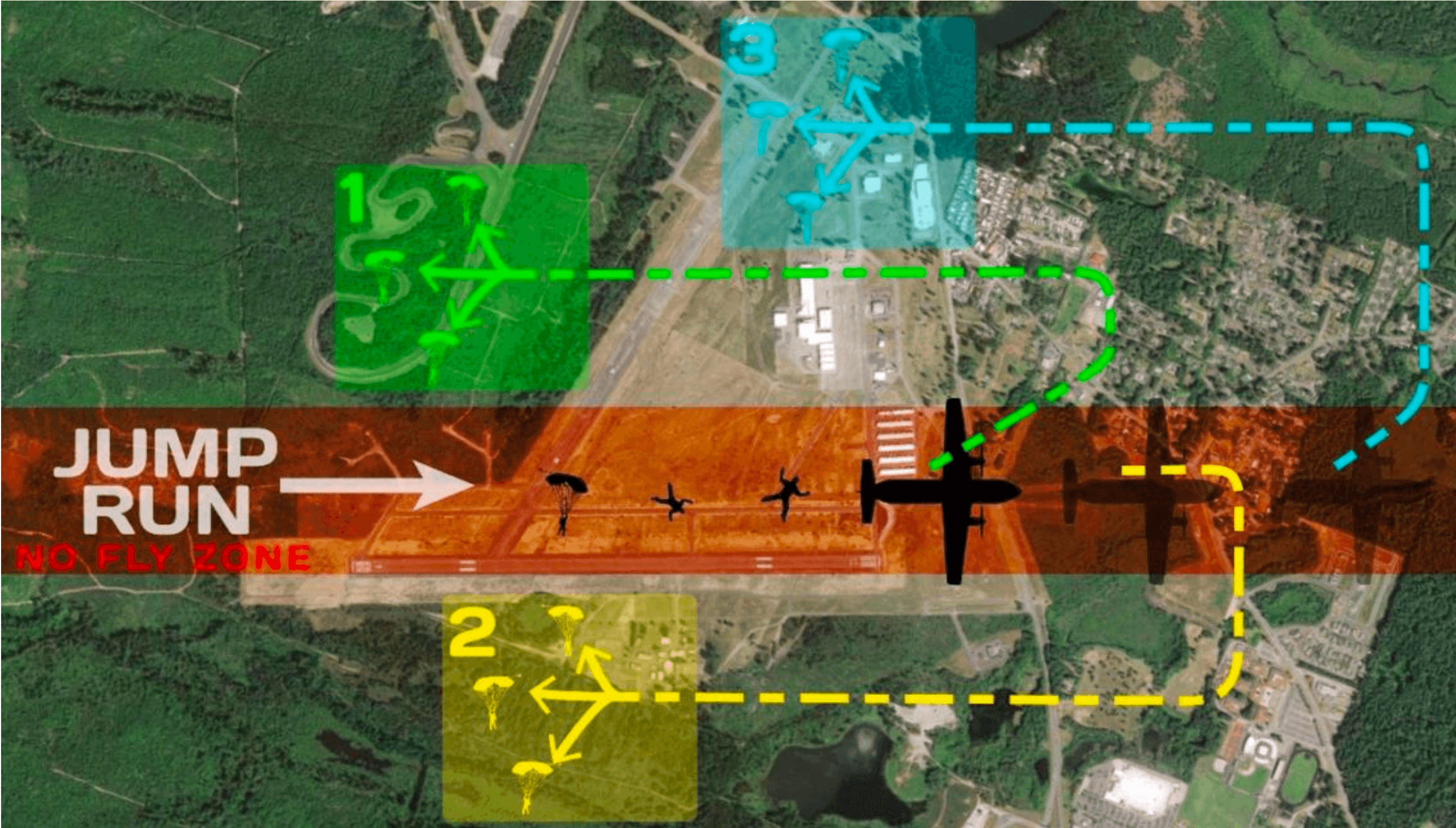
Under no circumstances should a wingsuiter approach an open sail during flight. Of the exceptions (such as XRW) may be made with permission of the Controller Technical and an appropriate briefing with the paratrooper(s) involved.
• For the first 25 wingsuit jumps, it is recommended to perform them with low cloud cover (1-2/8 octas), no large clouds and a good view of the ground.
• For more experienced wingsuiters, it is recommended to fly with a cloud cover up to 5/8 octas, always in agreement with the Manager Ground technique.
The octa scale above is for informational purposes only. When in doubt on developments in aerology, seek advice from the Technical Manager, WS instructors and the pilot.
c. Opening altitude
• The maximum opening altitude is 1500 m (5000 ft) so as not to obstruct traffic aerial and the minimum altitude is 1000 m (3300 ft). Exceptions may be authorized with the agreement of the Technical Manager.
• For the first 25 wingsuit jumps, the minimum opening altitude recommended is 1400 m (4500 ft) due to stress factors possible additional factors such as poor position when opening, difficulties to catch and throw the extractor, the twists,... It can then be reduced gradually.
• From 26 to 100 jumps, a minimum altitude under open canopy (main or reserve) of 1000 m (3300 ft) is recommended. When switching to a new model of wingsuit/to a larger model, it is recommended to adjust the opening altitude.
• It is the responsibility of the wingsuit pilot to determine the opening altitude suitable for being under an open sail at the intended altitude.
• In the case of XRW jumps, agreement must systematically be given by the Technical Manager and the jettison pilot. The proximity of an airport and a intense air traffic is incompatible with the presence of an open parachute above 2000 m (6500 ft), unless otherwise authorized
8. Program of progression and certificates:
a. Recommendation of group of certificates
• If a skydiver is not a known wingsuit pilot within the club, a minimum FAI-C license (or national equivalent) is required with membership to the ROI and a briefing by a wingsuit instructor from the club (safety, cartography and navigation, position at exit, etc.)
• The para may also be asked to show/prove his level of experience through videos or reference paratroopers, which must be validated or approved by a wingsuit instructor.
• If it is not clear, a test jump may be requested to assess experience and a level will be assigned by the RT and/or a wingsuit instructor.
• When the level of experience is not considered sufficient for the combination concerned, the para may be refused authorization to jump in this wetsuit or be asked by the club to jump into a wetsuit small in the different DZs of Belgium.
• Note that some pilots may be less familiar with the addicted, flying dynamic or head-down flight and may have already progressed with a larger combination. These paratroopers are also advised to start level by mastering the different skills of wingsuit flying and following progression levels in order to improve safety (and fun). Although the emphasis is often placed on performance, the minimum number of jumps recommended by the manufacturer must be respected.
• When a para upgrades to a larger or more efficient wingsuit (including in the same category), it is recommended to increase the opening altitude (margin physical and mental) for the first jumps and until having openings clean and regular.
• The most experienced wingsuiters in a group should keep an eye out and try to evaluate the level of the participants and the skill level for the jumps several.
• It is the responsibility of every wingsuit pilot to fly safely, predictable and responsible.
• He is obligatory that the student follow the order sequential of progression of A to F described below.
• Levels beyond D (dynamic and head down) are optional for the student and it is strongly recommended to be briefed by an expert wingsuit trainer in these areas.
• When of passage of a certificate superior, the instructor W.S. will be particularly attentive to factors humans (i.e. the involvement of candidate in the discipline) thus that at number of jumps in wingsuit during the year who has preceded. Requirements to start the Permissions after Certificates Naming certificate1 level got the
•
• Beginner Wingsuit WS-A (FFC) C certificate (FAI equivalent) Solo wingsuit on stomach
•
• Hardware check Beginner wingsuit (cat. 1)
•
• Wingsuit first flight course briefing Wing loading <1.3
•
• FFC test jump with instructor No tandem or AFF on the plane (recommended)
•
• Beginner wingsuit WS-B Certificate WS-A Up to 3-way on the stomach (no leading) BOSS
•
• >10 solo WS jumps Beginner wingsuit (cat. 1)
•
• Formation flight briefing Wing loading <1.3
•
• BOSS test jump with instructor No tandem/AFF on the plane unless min WS-C leads jump (recommended)
•
• Wingsuit WS-C Certificate WS-B Up to 7-way on the stomach Intermediate
•
• >75 WS jumps Up to 3-way on the back
•
• Test jump with video (below) Intermediate wingsuit (cat. 2)
•
• Briefing transitions / back flight / barrel rolls Wing loading <1.3
•
• Advanced Wingsuit WS-D Certificate WS-C Bigway wingsuit training
•
• >200 WS jumps (Small dynamic groups with
• instructors or leader level E) Test jump with video (below)
•
• Advanced Wingsuit (cat. 3) Big ways briefing (Dynamic briefing) 1 Group sizes may be larger than shown here when larger wingsuit pilots experienced (certificate more high) se join at jump. He must however note that the participants additional requirements require increased caution and may create distractions for children
•
• Dynamic Wingsuit WS-E Certificate WS-D Dynamic
•
• Test jump with video (below)
• Dynamic briefing (head down briefing)
•
• Wingsuit Head down WS-F Certificate WS-E Head down
•
• Head-down briefing Advanced Wingsuit (cat. 3)
• Test jump with video and instructor approval
•
•
• Instructor WS Instructor Instructor certificate D A-C license approval Initiator (approved
•
•
• WS Instructor Instructor certificate E (100 jumps dynamic + A-E license approval by the dynamic dynamic instructor approval FWCP)
•
• WS Instructor Instructor certificate F (100 jumps head down + head down head down instructor approval
• A-F license approval b. Recommendations for WS qualifications and points to cover during the briefings and tests
I. Wingsuit A - Beginner (= FFC course passed)
Conditions:
• FAI-C license (or national equivalent)
• Equipment check
• Wingsuit briefing first flight course (FFC)
• FFC flight test jump with the instructor
Briefing:
• First flight and safety course
• Navigation
• Knowledge of the equipment (equipment preparation and preparation autonomous)
Learning Objectives:
Stable flight on the belly, stable exit, correct navigation, awareness of the flight path jump/flight line, correct altitude, practice control handles, signal correct deployment and at the correct altitude (video proof required).
Recommendation/authorization after reaching this level
• Belly solo in a wingsuit
• Beginner's combination
• Wing loading of the sail <1.3
• No tandem - No AFF in the load
II. Wingsuit B - Beginner BOSS (group flight)
Conditions:
• WS-A
• >10 solo jumps WS
• Formation flight briefing
• BOSS test jump with coach (see below)
Briefing:
• Formation flight, trajectory, role of the base and the leader (or next to the base, not approach like a dive bomber), fly stable in the group, dangers, turbulence, separation,
• Types of exits, level flight, appropriate braking and acceleration, movements controlled (up and down, sideways), approach to a base, position, quadrants.
• Cow landings and what to do. Emergency wingsuit evacuations
• In case of loss of visual with the base: Step 180°, fly towards the opening zone and shoot at the intended height!
• Fly stuck to the base! (when safe to do so)
• These skills are mandatory and allow a person to start jump safely with a maximum of 3 wingsuiters in a group.
Learning Objectives
• Jump 1: Student follows coach in a series of up and down movements. descent.
• Jump 2: The student follows the coach in a series of braking movements and acceleration.
• Jump 3: The student continues to fly relative to the instructor for a series of unplanned three-dimensional movements.
Recommendation/authorization after reaching this level
• up to the 3-way ventral combination (start with the 2-way before switch to 3 lanes, no direction)
• Beginner's combination
• Wing loading < 1.3
• No tandem - No AFF in charge unless an experienced pilot (WS-C or no longer) is in the lead. (jumping with other people creates a distraction additional)
III. Wingsuit C - Intermediate
Conditions:
• WS-B
• >75 WS jumps
• Test jump with video (see below)
• Briefing on transitions, inverted flight and rolls
Briefing:
• Performance flight techniques to optimize speed and lift to achieve maximize free fall time, distance and/or speed, angle of attack when from a wingsuit jump.
• The student learns the different techniques necessary to maximize the time of free fall, distance or forward speed during wingsuit flight and how working with a flysight.
• Transitions, backfly and rolls,
• The student is explained the techniques necessary to perform a barrel roll while maintaining course and orientation.
• The student is explained the techniques necessary to carry out an exit from backfly and a transition during the jump, while maintaining heading and orientation. The student must be accompanied during the jump by a leader who can determine the flight line. For solo backfly jumps, a maximum of 5 seconds of flight continuous on the back is allowed.
• How to lead a group (in the clouds and in the blue sky)
• Note: Take a look at the following website on wingsuit acro which is excellent for exercises and plan some time in the indoor wingsuit tunnel in Stockholm, Sweden.
http://www.flylikebrick.com/safety-training.php; http://www.wingsuitcompetition.com/# Targeted learning objectives:
• Random stable output chosen by the coach (front, running, step videoman, etc.)
• Fly flat, seize, do a 360 around the coach, seize. (video proof required)
• Planning a jump
Recommendation/authorization after reaching this level
• Up to 7 channels if you are on your stomach (gradually increase the size of the group)
• Up to 3 lanes if you are on your back
• Intermediate combination
• Wing loading <1.4
IV. Wingsuit D - advanced
Conditions:
• WS-C
• >200 WS jumps
• Large training briefings
• (Dynamic Briefing)
• Test jump with video (see below)
Briefing:
• Points of attention for big way training (sectors, security, etc.)
• Importance of smooth and predictable flight
• the student receives instruction on the techniques required for relative flight to the rear. Go up and down, move forward and backward in relation to the leader.
• Separations, what to do in the event of a big mess in the base?
• Why the Dynamic flight requires additional briefing
• Flying at a very steep angle increases the risk of accidental opening!
Targeted learning objectives:
• Organize a jump with others
• Appropriate technique for exits, rolls, transitions between flying on belly and back flight, transitions between back flight and back flight stomach, while maintaining good navigation and awareness of altitude + return flight, flight slot and grip (video proof required).
Recommendation/authorization after reaching this level
• Bigway wingsuit training
• Dynamic flight in a small group is authorized with a leader or a holder of level E when briefed by a coach.
• Large combinations are allowed but it is recommended to learn these techniques in a smaller suit.
• Rodeo, Humanzee (trapeze), XRW authorized after a specific briefing by a experienced coach on dangers (flat spins, entanglements, collisions, etc.). For XRW always with the coach, the group decision comes back to the coach and the sailing pilot).
v.
Wingsuit E - dynamic
Conditions:
• WS-D
• Dynamic briefing
• Test jump with obligatory video proof (with the coach or wingsuit pilot level E, see below)
• (Head down briefing) Dynamic flight briefing
• The student receives a briefing on dynamic flight (sharp turns, 270°, flairs, eagles, ...) and the dangers linked to situational awareness, flying out of formation, high speeds, turbulence, flight path and the importance of a appropriate leader, with increased difficulties of orientation in 3D.
• It is important not to fly in the drop zone and to plan the navigation, especially if there are tandems or AFF paratroopers in the Load.
• The student must be accompanied during the jump by a coach or a dynamic leader (E certificate) which can determine the flight line.
Learning Objectives
• Perform 2 different dynamic jumps in a combination of 3 movements.
Recommendation/authorization after reaching this level
• Dynamic jumps
• Authorized to fly in larger dynamic formations (watch out for high speeds).
• During complex jumps, be aware of the work capacity of your brain!
• (2 - ways head down allowed at the end of the charge with the trainer or holder of level F when briefed by a coach)
• Large combinations are allowed but it is recommended to learn these techniques in a smaller suit, which can also lead to obtaining of a certificate E.
VI. Wingsuit F - upside down
Conditions:
• WS-E
• Head down briefing
• >5 head down jumps with the instructor
• Test jump with obligatory video proof (with coach or wingsuit pilot of level F, see below) Head down briefing
• Flying upside down and the dangers it involves and not hearing the sound. Importance of positioning in the load, visibility on the ground, exit, carving start, take-off/separation and separation altitude, dangers, flying head down with FF or belly, etc.
Targeted learning objectives:
• Left and right carve video (obligatory video proof, carve initiation).
Recommendation/authorization after reaching this level
• head down, also with FF sit-fly, tracer or ventral
• (start with a small group before moving to a larger group!)
• Combined dynamics, head down jumps allowed
• Large combinations are allowed, but it is recommended to learn these skills in a smaller combination, which can also lead to obtaining the E certificate.
VII. Wingsuit Initiator/Instructor Requirements (Required)
WS/FFC Instructor
• >200 WS jumps
• Certificate W.S. D
• Instructor course (see manufacturer - Intrudair, Phoenix-Fly, ...) and supervised coaching + video of a jump WS Dynamic Instructor
• Certificate W.S. E
• >100 dynamic WS jumps
• Dynamic Instructor Approved Workout Jump Head Down WS Instructor
• Certificate W.S. F
• >100 head down WS jumps
• Approval of jump supervision by a Head Down instructor (see list FWCP 2024)
VIII. Recommendations regarding training level
The level of training follows the general recommendations of the regulations for the skydiving. If a parachutist W.S. with a certificate wingsuit A or B has a interruption over 6 months, it is recommended that he receives a briefing (refresh) from an instructor WS.
If a holder of certificate >C has a interruption of more of 2 years and that the para has ambition to wingsuit again, a briefing (refresh) from a WS instructor is necessary and at least 1 wingsuit jump must be performed in a category I suit while being followed by the instructor.
| Brevets | Dénomination | Exigences pour démarrer le niveau | Permissions après avoir obtenu le brevet1 |
|---|---|---|---|
| WS-A (FFC) | Wingsuit Débutant |
|
|
| WS-B | Wingsuit débutant BOSS |
|
|
| WS-C | Wingsuit Intermédiaire |
|
|
| WS-D | Wingsuit Avancé |
|
|
| WS-E | Wingsuit Dynamique |
|
|
| WS-F | Wingsuit Head down |
|
|
| Instructeur (approuvé par la FWCP) | Initiateur |
|
|
9. List of wingsuits available on the market
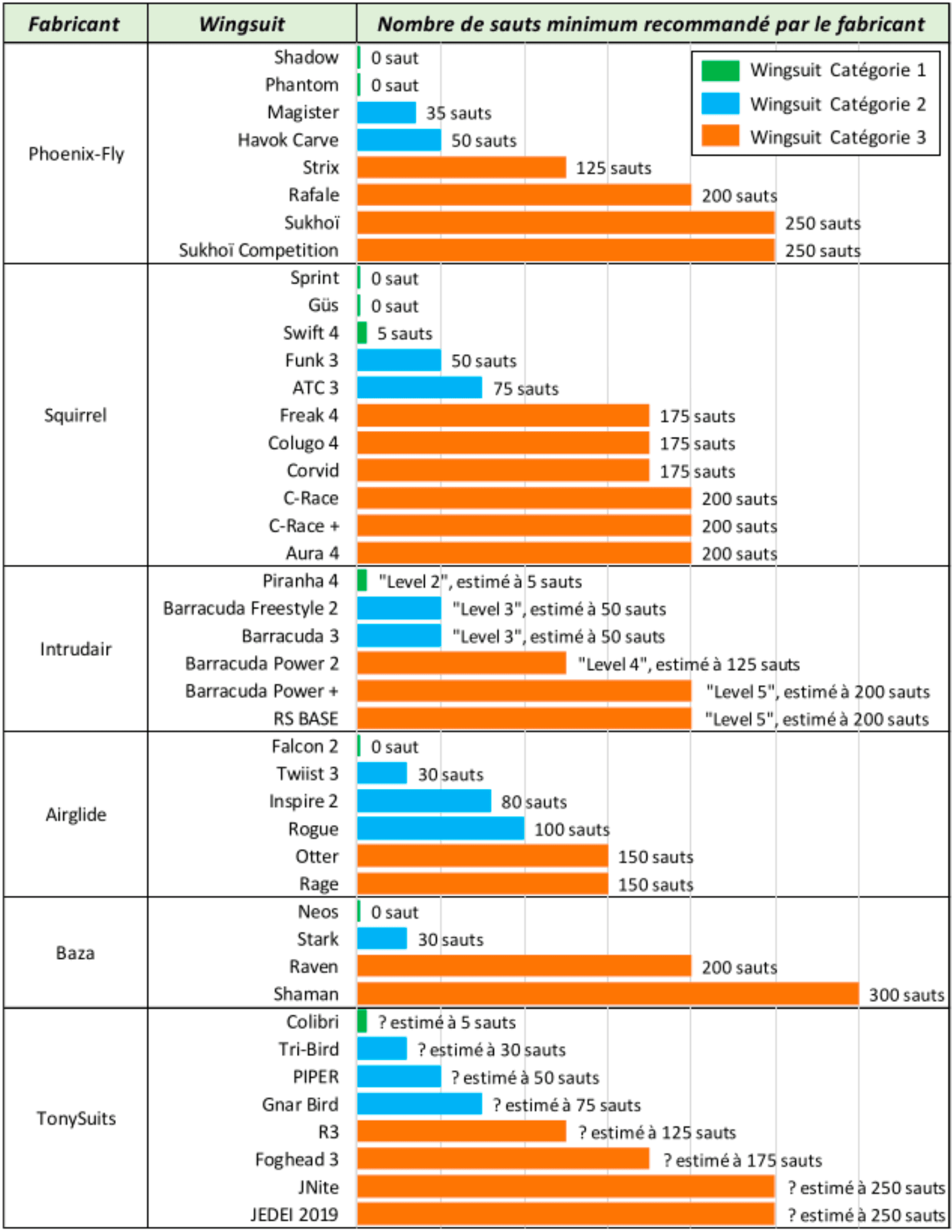
10. Types of wingsuits and classification by categories (ref : doc technical FFP)
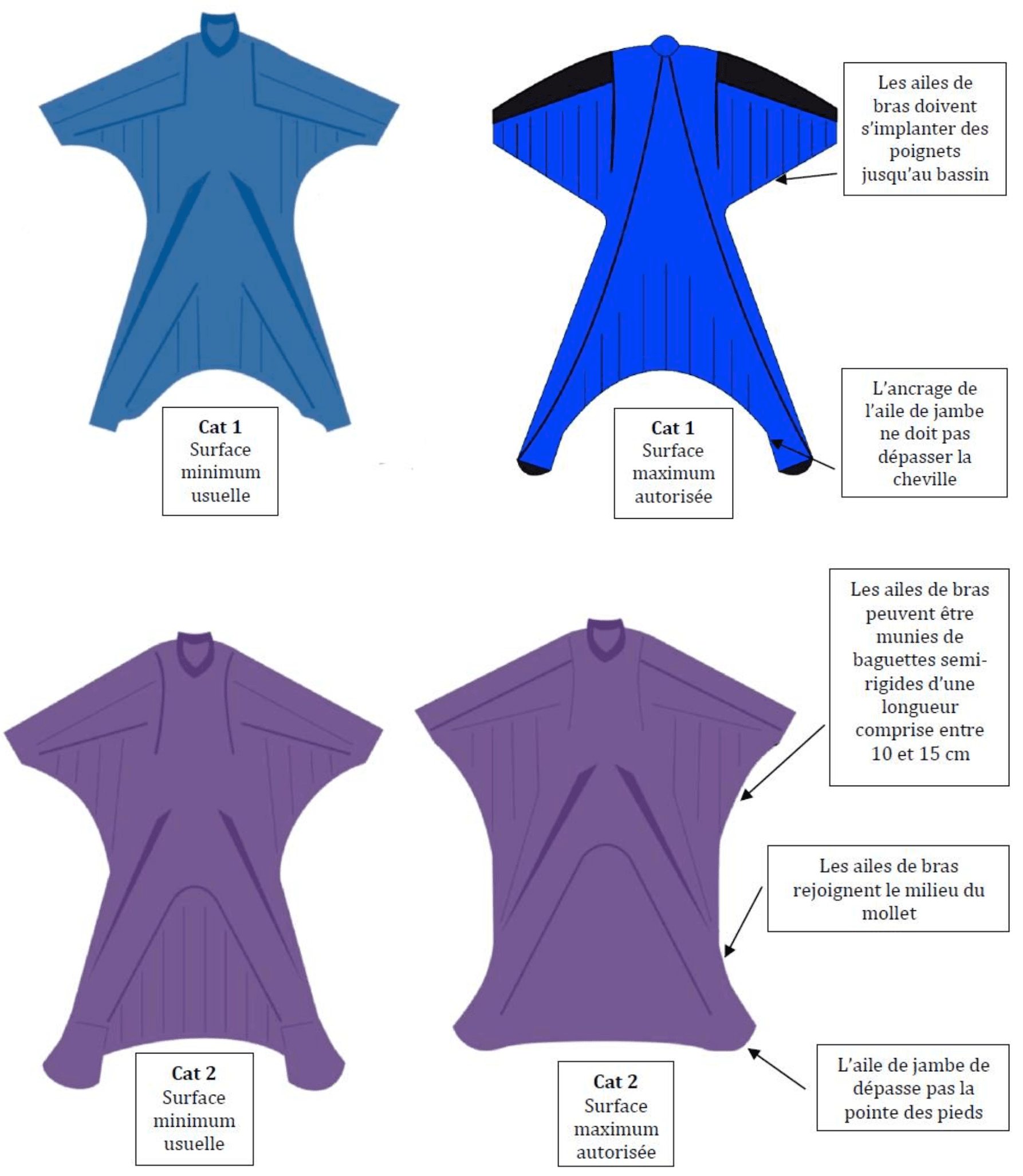
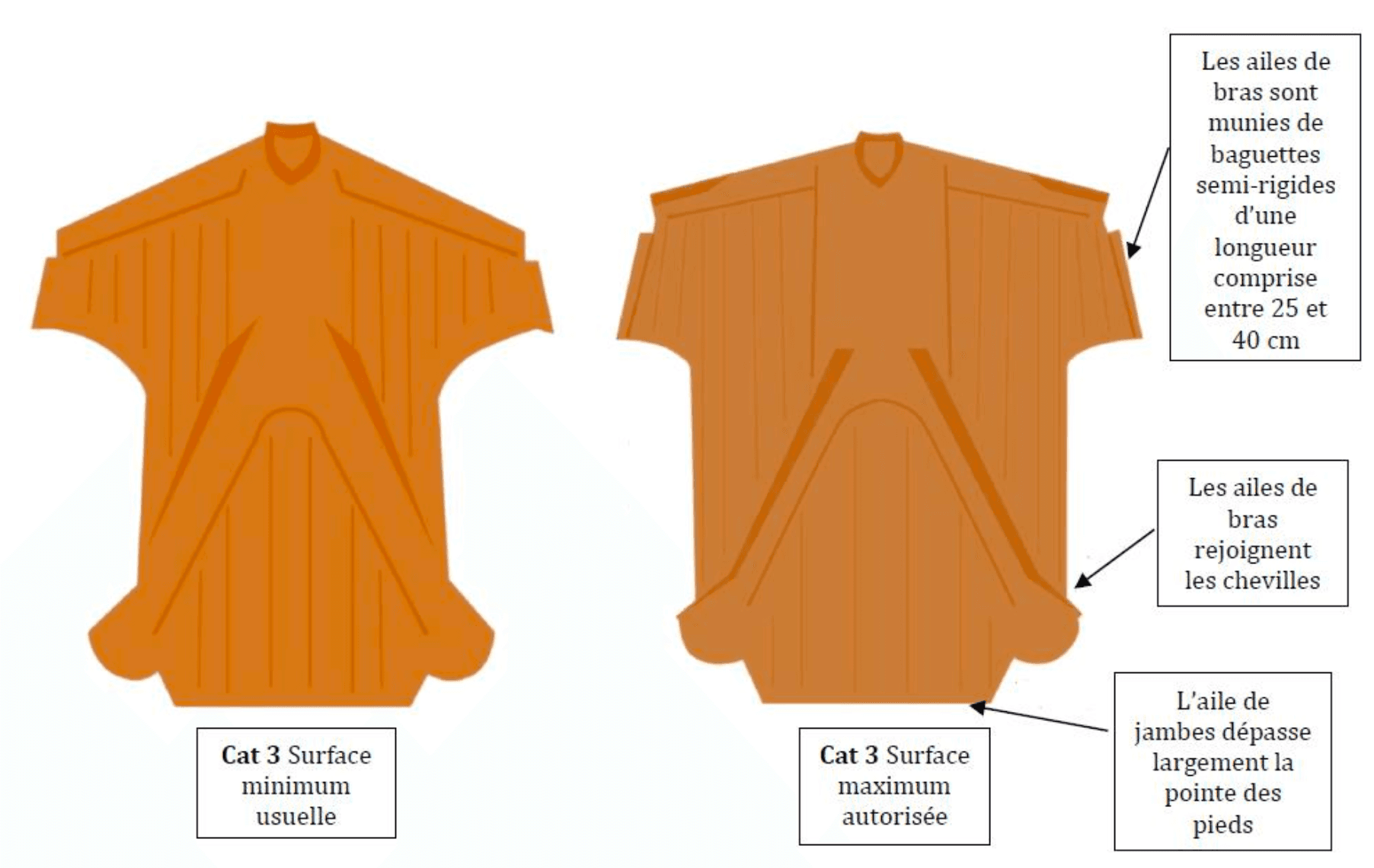
11. Tips for jumps of “Human Zipline"
Here are some technical and security considerations to take into account:
• The equipment: the distance between the handle (bar) and the climbing harness must be as short as possible to avoid a pendulum effect. A release system is recommended but not essential if the handle is short enough not to interact with the BOC. If the passenger wishes to put his feet in the rudder pedal, he then it is essential to have a release.
• A full-face helmet is strongly recommended: a nose filler at the exit can easily occur, and the lifter tends to rise towards the face when opening.
• The release and reserve handles should ideally be non-pickable: at the exit, the passenger could easily hang them!
• The shoulder belt: the pressure is exerted on 2 or 3 lumbar muscles. It hurts... a plaque semi-rigid at the rear of the harness to distribute forces over a wider area. Good muscle gain is not a luxury.
• The wingsuit: ideally Category 2 or 3: the flight is quite degraded and a WS Category 1 would not allow us to move forward.
• The exit: the passenger leaves with his back to the engine in perfect synchronization with the pilot see a chirped afterwards. If necessary, hold the passenger by the shoulders and give them the tempo. It is best for the passenger to leave with their arms bent.
• Flight: to fly well, you must keep your body tense as much as possible, and pull the grippers and
• The passenger is more comfortable when flying inverted. The strength needed to hold on is not important because the air carries part of the body's weight. Ideally it keeps legs straight and apart.
• Followed by other wingsuiters: speeds are very important. They recommend following with a WS of a lower category (ex. a Havok to follow a Freak).
• The flight angle is very steep, it is better to make a carved S approach instead than a straight line approach. This requires technique and a good sense of orientation... A little trick to descend faster without degrading the flight: crush the wings of the arms by bringing the wrists towards the hips (while keeping the arms, trunk and legs stretched).
• Tracking by freeflyers/trackers/tracers is almost impossible.
• For all these reasons, it is very important to be accompanied by EXPERIENCED WINGSUITERS equipped with well-mastered wingsuits!
• Transfer of the passenger to another wingsuit (W2): it seems easier to do so recover in inverted flight. The passenger must fly face down. The W2 must be positioned so as to place the passenger's knees under their armpits. He must lift the passenger. It is only at this moment that the passenger can release the rudder pedal. If the passenger lets go too high there is a risk of a painful collision... Here too, Non-pickable lib-reserve handles are essential. The station wagon with the W2 must be done at 2000m.
• The circuit must be well briefed with the passenger. If it lets go at 2500m it must be aware that he is far from the terrain and that he will have to pull high enough and the passenger must have time to orientate yourself and possibly shoot higher.
• Required level: the passenger must be stable on their back and stomach. He must be able orient yourself easily and manage a landing outside the area without hesitation. Carrying a telephone is essential. It is therefore strongly recommended to have an excellent visibility of the ground!
• It appears that a minimum of 200 WS jumps and at least 100 jumps with his wingsuit (category 2) is a reasonable prerequisite. Finally a good condition physical is not a luxury.
Appendix G : Manual of fall free with camera
1. Preamble
This manual was deeply inspired and translated in part from the manuals of the British and Australian Parachuting Federations:
• British Skydiving - Camera Manual https://britishskydiving.org/wp-content/uploads/2019/05/Camera-Manual.pdf
• Australian Parachute Federation Ltd - Camera FLying Guide https://www.apf.com.au/ArticleDocuments/836/Camera_Flying_Guide.pdf.aspx?E mbed=Y
2. Introduction
The aim of this document is to make skydivers aware of the risks associated with jumps with on-board camera. He goes through the concepts of safety and emergency procedures in order to reduce these risks.
Note: The information available in this document is intended for skydivers confirmed already meeting the mandatory criteria necessary for camera jumps.
Jumping with a camera is not trivial and must follow deep thought beforehand.
“Not everyone is capable of jumping with cameras, even after several hundred of jumps”.
3. Prerequisites of the FWCP for jump with a camera
• Certificate C (200 jumps + theoretical exam)
• A helmet endowed of a system of liberation or be “ snag free » according to the prescriptions of the section 4.4.
• Mandatory audible altimeter
4. Who can teach the procedures emergency ?
Before jumping with a camera, it is important to follow a briefing with a qualified person and this manual can be used as a support. Safety is the axis central used during such a briefing! The people qualified to give this briefing are:
• Technical manager
• Video instructor with in-depth knowledge of video equipment, out-of-area landings and this video manual.
5. Objectives of briefing
• Raise awareness and inform about helmet camera mounting systems
• Develop the student’s knowledge and teach them the skills necessary
• Show and inform about possible errors and incidents related to camera theft
• Inform and practice emergency procedures
• Train the student through visual and interactive examples
• Complete the student’s jump logbook stating that they have received the briefing and assimilated it
Section 1: Risk awareness
Filming and/or taking photos of skydiving can be fun, rewarding and can even prove to be one of the best ways to progress and learn thanks to debriefing of images after a jump. Keep in mind that using video equipment should be the last priority when checking your hardware.
It is recommended to turn on your camera before you enter the door to give yourself the time to mentally focus on your jump without the cognitive load associated with your video equipment. Throughout the rest of the jump through the glider, landing and your return to the hangar, stay focused and aware of your surroundings!
Many incidents have taken place and still take place as a result of low openings in the purpose of capturing the moment or to make a grip for the video. There were also collisions under canopy and landings out of area due to the reduced field of vision due to cameras. It is essential not to focus on a specific point for your images (tunnel vision). Ask yourself whether flying with a camera for a jump too Ambitious is a good idea even if you have experience.
We are first and foremost skydivers and secondly videographers. It is important to remain aware of other skydivers, the landing zone, the circuit and our altitude.
Section 2: The helmet
The headset is the basis of the videographer’s work tool! It is the foundation that will allow to increase the quality of images and the safety of the skydiver. Take into consideration the following points when choosing your helmet.
2.1 The release system
• A system of liberation is strongly recommended for jump with a camera. In sound absence, a system completely “ snag free » and validated by a RT must necessarily be in place (see section 4.4.).
• How does this system work? Release your helmet to the ground and gather it system to really understand how it works.
• The release system will be ideally placed on the chin bar because it is easily located in an emergency situation and very unlikely to be caught by the elevators.
• The system must be firmly mounted on the helmet to avoid triggering untimely.
2.2 Suitable size
The helmet will be ideally adapted to your head size to avoid any shaking or shaking. In addition to obtaining better images, the risk of injury to the Necks are potentially reduced when heavy cameras are mounted. A Hard chin bar also allows the helmet to be more securely attached to your head.
Note: some professional skydiving videographers advise purchasing a helmet one size smaller than its own helmet size. Before purchasing, try it helmet or a helmet of the same size to ensure it will fit properly.
2.3 Auditory altimeter
The use of an auditory altimeter is mandatory for each type of camera jump.
It is a precious, even essential, aid to help each videographer keep awareness of altitude despite the distractions of taking images while falling.
2.4 Helmet shape and design
The shape of the helmet is an important factor and several manufacturers have created models dedicated to the use of cameras. Helmets with a “square” appearance reduce considerably the risks of hanging lines or halyards in the cameras.
In the same vein, a release system does not give carte blanche to everything camera mounting system and everything must be implemented by the skydiver to minimize the risk of snagging your helmet. Many solutions exist and continue to be invented thanks, in particular, to democratization 3D printers. It is more possible than ever to create a video setup presenting little or no prominence capable of hooking lines or halyards.
See Section 4 for more information on setup
Section 3: Camera Models/Camera
3.1 Action cams
Small camera models dedicated to sports (or action cams) are the models recommended for your first jumps as a videographer. Their simplicity, size and weight make them the ideal candidates to learn and gain experience while minimizing risks associated with their use.
3.2 Reflex and other large devices
SLR/hybrid cameras and other large hardware are, ideally, reserved for skydivers who have at least 100 video jumps and demonstrate ability and indisputable experience using a single camera in free fall.
3.3 Camera size and weight
The total weight of your helmet is an important point because heavy equipment can inflict serious injuries when opening at the neck. Also, the bulk and size equipment embedded on a helmet presents a risk of snagging lines/halyards as well as the risk of shock when putting in the door or
3.4 Simplicity
Your gear is an added distraction before and during your jump. The more model is simple to use, the more you can concentrate on your jump (See point 3.1)
3.5 Intended use
Is the “setup” used suitable for the planned jump? Will the use of my material appears to present a security risk? For most skydivers and for most jumps, carrying a simple and unique action cam will be sufficient.
See Section 4 for more information on setup The lighter and simpler your helmet configuration, the safer your jump will be!
3.6 Distractions
Minimize possible distractions involved with your camera system:
• Is the camera in my field of vision?
• Does my camera prevent me from performing emergency procedures?
Be sure to practice your emergency procedures (helmet release, sail release main and emergency parachute deployment) with your helmet configured on your head and determine that it is not inconvenient for you to carry out all these procedures.
Section 4: Configuration or “setup”
There are several factors to consider when mounting a camera on your helmet or on your body. Consider all possible options and take the time to analyze them to find the arrangement presenting the least risk.
4.1 Location
• Is the location of the camera safe from potential exposure and the angle is the camera correct at this location?
• Will the camera make my deployment awkward or uncomfortable? Particularly important for the use of Hand cams.
• Do I have easy access to all my handles?
• Can my equipment affect my field of vision?
4.2 Risks of snagging
As seen in the previous points, the risk of collision is an omnipresent risk when using one or more cameras in a fall. Here are some tips for reducing minimize the risks generated by a video headset:
• Invest in dedicated camera mounting options for video (See point 2.4) and be constantly seeking to optimize your “setup”
• Place a line, cord, halyard on your helmet and note the points
• Mount a plate or camera on your helmet with materials such as sticky foam or nylon screws instead of metal screws is a way to reduce the impact that collisions can have on your cameras.
4.3 Installation safety
Make sure the mounting of the hardware is secure enough not to come loose unexpectedly falling and causing a danger to people and equipment ground. Also make sure that this assembly is still subject to breakage under strong tension in the event of snagging in the lines or in the halyard of an extractor.
4.4 Disassembly of the camera
When doing jumps that don't require a camera, it will be very useful to be able to easily remove the latter or have a helmet without a camera so as not to burden yourself unnecessarily with the risk of snagging. Also, a modular setup allows you will allow you to adapt your helmet as best as possible to each situation and thus reduce as much as possible the risks associated with its use.
Section 5: Accessories
Certain accessories can prove very dangerous for parachutists in particular by an increase in the risk of collision. Each accessory must be considered with the greatest precaution and in agreement with an RT. A RT may need the advice of a Experienced skydiver videographer.
5.1 Ring sight
The ring sight is a device allowing you to aim and frame very precisely. He should not be used only by videographers who are already very experienced and perfectly aware of the risks associated with such a device.
Here is a non-exhaustive list of risks related to the use of Ring sight:
• hooks and tangles with a brake control
• Accentuated vision tunnel
• Deterioration of visibility
• Risk of snagging with the extractor if the system is fixed on its side as well as risk of snagging in the lines It is strongly recommended that any additional accessories attached to the helmet be detachable under a certain tension (nylon screws are, for example, recommended for mounting a ring sight).
It is also recommended to carefully study the assembly of a device like the ring sight to expose the latter as little as possible to the risks of snagging and sawing as quickly as possible the mounting rods when the final position has been established and mounted.
Section 6: Parachute deployment
Cameras save weight on the head. This results in an increase in risk of neck injury. It is recommended to only take on board the strict necessary and to optimize its setup so that it is as light as possible.
6.1 Wings
It is advisable to follow a briefing before jumping for the first time with a suit or jacket equipped with wings from a parachutist experienced in this discipline. The briefing should address the following points:
• Ensure that the space between the wing and its attachment point does not allow the extractor to pass through
• Ensure ample and exaggerated movement that does not pass through the space between the wing and its attachment point to reach its deployment handle
• Make sure the wing is not too wide or soft to catch the extractor when the opening phase
• Ensure that the wing tensioning loops are carried above gloves to be removed quickly in an emergency and to be able to catch the risers/handles freely.
Note: Ground deployment movements must be performed on the ground to reinforce the points cited above.
It is also recommended to perform a first jump with wings solo and without a camera.
to get used to flying with the wings and above all to perform several control handles.
Obviously, such a jump should not be a low altitude jump and should be performed at 4000m.
During the opening phase, the wing of the free arm prevents it from extending to perform a normal deployment movement. One of the ways to prevent this arm from retaining a inflated wing generating a rotation is to place your elbow against the torso folding thus the latter. Another way is to perform a symmetrical opening movement with both arms, accentuating the arch by lifting the chin so as not to sting.
6.2 Extractor and halyard
The use of an extended halyard and a wider extractor reduces the risk of shaking or hesitation of the extractor during deployment when flying with wings.
6.3 Position of the head when opening
The videographer will have to raise his head to look at the horizon during the opening and thus promote a natural position to best support the deceleration of the opening.
Particularly in case of dry opening.
If the head is tilted too downward, a sharp opening will pull the shoulders toward the rear inflicting a brutal blow on the videographer’s neck. This blow will be accentuated by the weight of the video equipment present on the headset often causing serious injuries.
6.4 Sailing
The risks associated with the use of a camera can be mitigated by a suitable sail. More your setup is heavy, the more it will be recommended to use a docile and large sail. Of Relatively harmless twists without a camera can quickly become hell with a headset video.
Never watch your parachute deploy until it is completely open. Watching it increases the risk of snagging lines in your helmet and promotes bad openings Meticulously store the excess line from your half brakes to avoid snagging upon opening. Pay extra attention to your gear check, particularly at the pins, loops and your extractor pocket. Unexpected opening when you are in step video can cause a fatal accident for the entire plane and its passengers.
Section 7: Emergency Procedures
It is important to be completely comfortable with your “normal” emergency procedures without camera before you start considering camera jumping. In each situation, different factors can intervene. It must therefore be considered that each emergency procedure is unique and must be handled accordingly. Here is a list of situations that may arise when using cameras and accessories.
Note: Practice and rehearsals of ground procedures are key for you give the best chance of reacting well in a real situation!
When you decide to carry out an emergency procedure, you should always ensure you have enough altitude to release and deploy your reserve parachute.
7.1 Extractor/halyard tangled in the helmet
Trying to untangle a halyard in the helmet can take a lot of time.
precious time and altitude. Here are some likely scenarios:
• A disentangling attempt, if it fails, release the helmet. If the main sail deploys, check that it is open, undamaged and controllable. In case malfunction, initiate the usual emergency procedure.
• The main parachute does not deploy and is choked by the helmet, initiate the usual emergency procedure.
7.2 Landing in water with a video headset
During an unintentional landing in water, it is recommended to release a helmet video which may present several attachment points making separation dangerous with its equipment.
Section 8: Filming a tandem
When a skydiver wishes to film tandems, he is advised to contact a RT for advice and then he can start training following instructions.
tandems without camera to concentrate on exits, keep an appropriate sink rate and move aside when deploying the tandem parachute. These jumps must be preceded of a briefing with a instructor tandem. When the candidate has demonstrated that he was capable to follow the tandem in complete safety, he will then be able to film such jumps after having successfully the tandem videoman certificate.
8.1 Exit
The videographer will need to know exactly how he is going to exit, get into the door/on the step video. Ideally, practice on the ground on the model to review each detail, paying particular attention to its handles and pins.
The instructor tandem and the videographer must agree and communicate a maximum on the exit signal to exit before the tandem at a safe distance during deployment of drug. In Besides, agree on the signals in fall of the instructor tandem for indicating the distance from the landing area can be very useful.
Stay away from drugs at all costs and especially during their deployment.
Only approach when it is completely inflated. The drug can cause serious injury and cause entanglement. If, for a particular reason, you miss the exit timing, wait 1-2 seconds after the tandem jump to jump to your turn and thus have sufficient separation from the tandem and its drug.
8.2 Free fall
Never fly near or over the drug. Also, do not try to touch the latter or its halyard.
Avoid flying under the tandem at any time. An untimely opening will prove very probably fatal for the 3 parachutists.
Avoid grips with the passenger because they tend to grab you and not let go!
The ideal position is to fly in front or to the side of the tandem and slightly below of their level by filming them from a slight low angle.
Imagine a virtual cone around the tandem above and around the tandem and the dope.
Never enter this cone!
8.3 Opening
Take some distance when the tandem opens to avoid any kick due to spin of swing resulting from the opening.
Stay visible for the instructor tandem to the opening.
The instructor tandem must keep a eye on the area of laid and warn the case applicable sound videographer that he will open higher to give him the opportunity to also open higher and thus be able to enter the landing zone.
When the tandem has opened, the ideal is to drift for a few seconds and open as much as possible.
high possible.
8.4 Landing
When you have landed, it is easy to lose awareness of other skydivers who are land because of the concentration on the tandem whose landing you are going to film.
Stay alert and aware of your surroundings!
8.5 Incidents or dangerous situations
• The tandem is unstable to the exit : keep your distances and wait that the instructor tandem resume the situation in hands.
• If, despite your best efforts to avoid drugs, you find yourself in the zone to throw drugs. Do everything in your power to get out as soon as possible of this area!
• The instructor tandem is unconscious in fall : keep your distances and observe from afar. Deploy your parachute at a safe altitude and distance from the tandem.
• The drug is entangled with the tandem itself: do not try to help the tandem. Observe from a safe distance and deploy your parachute at an altitude sufficient.
• You are tangled in the drug : Be conscious that in this case, the instructor tandem going begin his procedure emergency who consists to disconnect sound RSL, release its main sail, release its main sail, drift a good distance and deploy his emergency parachute. Try by all means to free yourself from drugs that this either before, during or after the procedure emergency of the instructor tandem. After the tandem release procedure, you may become entangled in the main sail of the tandem.
Appendix H: Certificate Video Tandem FWCP
1. Prerequisites :
• Federation C certificate
• 400 jumps
2. Test physics :
The candidate must prove that he is capable of following a tandem in complete safety.
exiting the plane when his own parachute opens.
To do this, it must be filmed by an examiner or a video certificate holder tandem and provide this video to an examiner who will ensure the following points:
• Remote tandem exit
• Flight clear of the drug during the entire jump. No passage under the tandem
• Control total of flight (flight to level and predictable by the instructor tandem). Gap when the tandem will open
• Drift when the tandem has opened The candidate's practical exam jump is carried out with the camera on and will always be preceded of a briefing of security by the instructor tandem.
It is strongly recommended that the candidate train beforehand with the agreement of a instructor tandem for pass this jump examination.
The candidate must also know the emergency procedures of the tandem (procedures specific to the hardware manufacturer, for example: UPT Sigma).
Appendix I : Size of sails
1. Category of sails
Category I:
• Performance Designs: Navigator, PD F111 7 cell, PD F111 9 cell, Saber
• Aerodyne-int: Solo
• Firebird: Exit one, Spark (hybrid student)
• Parachutes of France: Prima, Drakkar, Turbo, Prime
• Precision: Falcon, Voyager (student version)
• PISA: Skymaster
• Paratec: Balance, Element
• Flight Concepts: Clipper, Manta, Manta ZP, Cruiselite
• NZ Aerosports: Student ZP7
• Parachute Systems: ZP Student
• NAA: Eagle 7 & 9
• Skylark Commodore
• Jojowings H.O.P. 260 Multi
• Icarus World: Equinox, Nano
• pilot
• Saber (student versie)
Category II:
• Parachutes de France: Electra, Merit
• Aerodyne-int: Pilot (Cat1 above 210ft2), Triathlon
• Paratec: Super 7, Quadra, V tec
• Performance Designs: Saber (Cat1 above 210ft2), Specter, Silhouette, Pulse, Zero
• Precision: Synergy
• NZ Aerosports: Omega
• Icarus World: Omni
• Variable performance: Cayenne
• Atair Aerodynamics: Dragon
• NAA: Parafoil
• Eiff: Eiff Classic
• Skylark Magellan
• Parachute Systems Ventus
• Jojowings H.O.P. Fun, H.O.P RW
• Zepo student
Category III:
• Aerodyne-int: Pilot7
• Performance Designs: Saber 2 (Cat2. </= 190ft2), Saber 3, Lightning, Storm, CF Storm, Horizon
• Precision: Fusion
• Big Air Sportz: Lotus
• NZ Aerosports: Safire 1, Safire 2, Safire 3, Kraken, Matrix, Matrix2
• Icarus World: OM-7, Sfire
• Strong: Z-po
• Paratec: Faqtor, NRG
• Atair Aerodynamics: WinX
• Big air sportz: Lotus
• PISA: Hornet
• Parachute Systems *: Zepo exe, Volt
• Performance Variables: Spark
• Flight Concepts: Express, Prodigy, Sentry
• NZ Aerosports: Matrix 2, Matrix
• Skylark Skipper
• Fluid wings: Prime, Nexus
• Squirrel: Epicenea
Category IV:
• Aerodyne-int: Diablo, vision, zulu
• Performance Designs: Stiletto, Saber 3
• Parachutes de France: BT, Springo, Electra XS, Springo NG
• Atair Aerodynamics: Ace, Cobalt, Alpha, Space, Impulse
• Flight concepts: Pro series, Rage
• Firebird: Cayenne Light
• Fluid Wings: Echo
• Paratec: Scorpion
• Performance variables: Contrail
• NZ Aerosports: Crossfire (1,2 & 3)
• PISA: Heatwave
• Parachute Systems: Hurricane, Vixen
• Jump Shack: Firebolt
• Jojowings Sonic
Category V:
• Aerodyne-int: Mamba
• Icarus World: Xfire
• Big Air Sportz: Samurai
• Atair Aerodynamics: Cobalt competition, Radical
• Firebird: Demon, Chilli
• Performance Designs: Katana, Vengeance
• Paratec: X Wing, Rage
• Parachutes de France: BT Pro, Instinct
• Precision: Nitron
• Aerodyne-int: Mamba
• Skylark Odyssey
• Jojowings Raptor
• X-wing
Category VI:
• Aerodyne-int: Sensei
• Parachute Systems *: V Max
• Performance Designs: Velocity, Comp Velocity
• Parachutes de France: Ninja, Ninja 2
• Accuracy: Xaos 21, Xaos 27
• NZ Aerosports: Extreme FX, Extreme VX, Neos, JFX, JFX2, JVX
• Atair Aerodynamics: Onyx
• Fluid wings: Helix, Gangster
• Skylark: Scirocco, Odyssey Evo
• Jojowings XF 15
Category VII:
• Parachute Systems: GTR
• Fluid Wings: Airwolf, HK, HKT, HKT2, Wairwolf
• Performance Designs: Peregrine, Valkyrie
• NZ Aerosports: Petra, Leia, Sofia, Sleia
• Paratec: XTC
2. Table load to the air vs. category of veil:
Wingload calculation: (weight + 10 kg) * 2.2 / canopy size = WINGLOAD
| Number of jumps | MAX WINGLOAD under canopy | Max canopy category | Minimum accepted size | ||
|---|---|---|---|---|---|
| WITHOUT course | WITH course | WITHOUT course | WITH course | ||
| 0 - 25 | 1 | 1.1 | 1 | 2 | 189 |
| 26 - 50 | 1.1 | 1.2 | 2 | 2 | 169 |
| 51 - 100 | 1.2 | 1.3 | 3 | 3 | 149 |
| 101 - 200 | 1.3 | 1.4 | 3 | 3 | 135 |
| 201 - 500 | 1.5 | 1.6 | 3 | 4 | 119 |
| 501 - 1000 | 1.7 | 1.9 | 4 | 5 | 99 |
| 1001 - 2000 | 1.9 | 2.5 | 5 | 6 | 79 |
| > 2000 | 2.5 | Free | 6 | 7 | Free |
Example: Person 70 kg / Sabre 150 -> (70+10) * 2.2 / 150 -> WINGLOAD = 1.17
Any canopy change must be reported and documented using a form available at manifest. Approval by a technical manager is mandatory.
Appendix J : Conditions of tandem Wingsuit
The Referent approved and approved by the FWCP is: Sky Vibration.
All technical information on the execution of tandem Wingsuits is provided on request by Sky Vibration.